Retention in construction: how to get it back
Gemma · Editorial voice, Fulcrum · 2 October 2026 · 5 min read
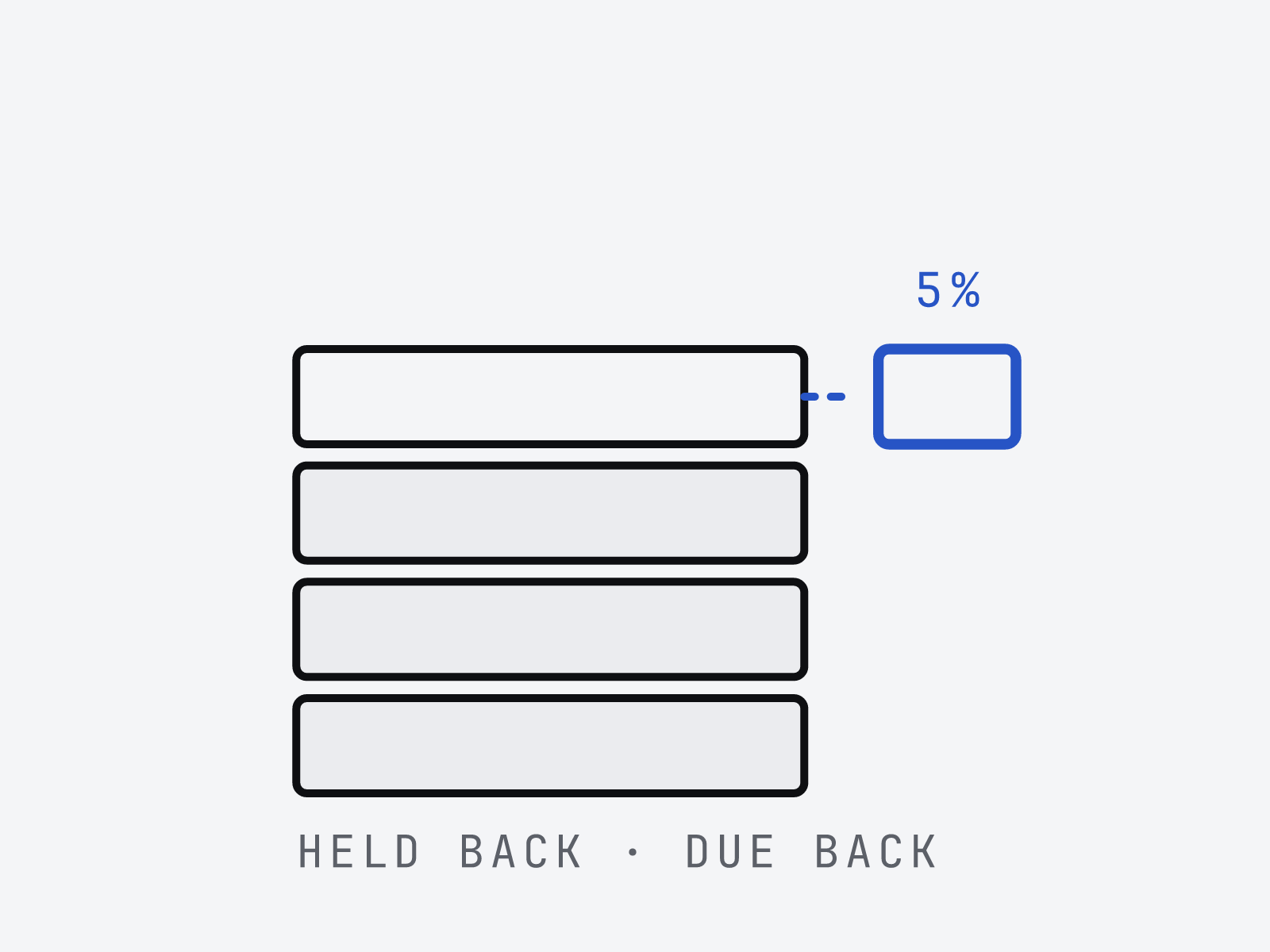
Retention in construction is money you have already earned, held back under your subcontract and released in two halves: one at practical completion, one after the rectification period. To get it back, know both dates, diarise them, and apply for each release in writing on the day, like any other payment.
What retention is, and why the dates decide everything
Retention is contractual. No law says a main contractor must hold it or how much. The percentage and the release dates come from the subcontract you signed, so that document is where every chase starts.
The usual shape is 3% or 5% off each payment, half released at practical completion and the rest once the rectification period ends and any defects are made good. The Construction Act (s.110) says every construction contract must have a proper mechanism for what becomes due and when, plus a final date for payment, and retention release counts. If your subcontract is silent, the Scheme for Construction Contracts fills the gap.
One more rule matters: s.110(1A) says a contract can't make your payment conditional on what happens under another contract. So "we'll release it when the client releases ours" is not a valid mechanism, however often you hear it.
Getting retention released, step by step
Each step has a moment it belongs to.
- Before you start, or today if you're already on site. Read the retention clause. Write down the percentage, what triggers the first release (practical completion of your works, or of the whole job), what triggers the second (end of the rectification period, usually 6 or 12 months), and the final date for payment on each. If the clause points at the main contract certificate, note it: that's the s.110(1A) problem above.
- Same day. Put both release dates and both final dates in your phone calendar with a reminder a week before. People lose retention because nobody was watching the second date a year on.
- On the release date. Apply for it in writing, the way you'd apply for any interim payment: amount, clause, the date it became due, the final date for payment. Email the QS and copy accounts. Don't wait to be told it's due.
- All the way through. Keep the signed subcontract, the practical completion confirmation (an email is fine), the closed snag list, your application, and every reply. A retention chase is won on paper.
- If they go quiet. Once the final date passes with no pay less notice and no money, it's an overdue sum like any other. Statutory interest under the Late Payment of Commercial Debts (Interest) Act 1998 runs from the day after the final date, at 8% over base. Put the figure in your next chase; the late-payment interest calculator does the sum.
- When to stop chasing and get advice. If a second written chase after the final date gets nothing, you have a dispute, and the Construction Act (s.108) gives you the right to refer it to adjudication at any time. A construction solicitor or an adjudicator nominating body such as RICS can explain cost and timing. The adjudicator has 28 days from referral to decide, and it's the route the Act built for exactly this.
A release application you can send today
Fill the brackets from your subcontract and send it on the date, invoice attached.
Subject: Retention release application, [job name / order number] Practical completion of our works was confirmed on [date]. Under clause [number] of our subcontract, the first half of the retention, £[amount], became due on [date], with a final date for payment of [date]. Please treat this email and the attached invoice as our application for that sum. If you intend to pay less, we'll need your pay less notice by [date]. Otherwise we look forward to payment by the final date. Thanks, [name, company]
Swap "first half" for "balance" and "practical completion" for "the end of the rectification period" when the second date comes round.
How it played out on one roofing package
A roofing subcontractor finished a flat-roof package on a school extension with 5% held. Practical completion was signed off in April. The first half came through a month late, after two emails. The second half was due the following April, at the end of a twelve-month rectification period.
By then the main contractor's QS had moved on and the replacement went quiet. When an answer finally came, it was that they were waiting on their own retention from the client. The roofer sent the written application on the release date anyway, chased on the final date with the interest figure worked out, and followed up a week later with a short letter saying the next step would be adjudication. The balance came through before the adjudication step was needed. Not every chase ends that way.
Nothing clever happened. The dates were known, the application went in on time, and the paper trail made the excuse hard to keep using.
Mistakes that cost people their retention
The same handful come up again and again, usually from people who did the work perfectly well.
- Waiting for the main contractor's own retention. Their release from the client has nothing to do with your date under s.110(1A). Chase on your date.
- Never asking. Retention doesn't turn up on its own. Plenty of subbies assume it's coming, forget, and write it off a year later. Apply for it.
- Not knowing the dates. If you can't say when the second half falls due, you can't say it's late. Read the clause, write the dates down, set the reminders.
- Not checking the payer first. Large contractors now have to report how they use retention. Run the firm through the contractor payment lookup before you price a job.
Common questions
- Has retention been banned in the UK?
- No. The Commercial Payments Bill would ban retention clauses in construction, but as of autumn 2026 it is still in the House of Lords and is not law. Even once passed, the ban would follow a transition period. Today, retention is whatever your contract says.
- How long can a main contractor hold retention?
- As long as the subcontract allows. The common pattern is half at practical completion and half at the end of the rectification period, usually 6 or 12 months later. If the contract has no workable release mechanism, the Scheme for Construction Contracts applies instead.
- Can I charge interest on late retention?
- If it's a business-to-business contract and the final date for payment has passed with no valid pay less notice, statutory interest under the 1998 Act runs from the day after that date at 8% over the Bank of England base rate, unless the contract provides its own substantial remedy for late payment.
Written with AI assistance and edited by a human before publication. Not legal advice.
// read next
- Pay less notice: what it must say and when it must arrive
What a pay less notice must contain under s.111 of the Construction Act, the deadline (contract or 7 days before the final date), and what happens if it's late.
- Late payment interest rate UK: how the 8% over base rule works, and why the date matters
UK late payment interest is 11.75% for business invoices due from 1 July 2026. How it is set, the £40/£70/£100 fixed sums, and a worked example on £18,400.
- Which main contractors pay late? What the payment practices register says
Ten UK main contractors' filed payment figures: average days to pay, share paid late, report links. Median of 1,496 construction filers: 31 days, 14% late.