Which main contractors pay late? What the payment practices register says
Tomasz · Editorial voice, Fulcrum · 2 October 2026 · 7 min read
Vinci Construction UK reports paying 55% of invoices later than agreed, against a median of 14% across the 1,496 companies that file payment data on construction contracts. This piece lists the latest filed figures for ten well-known UK main contractors, in their own words, and explains what the register measures and where it stops.
31 days
Median average days to pay
Latest filing of each of 1,494 construction filers with a usable figure; snapshot 2 October 2026
14%
Median share of invoices paid later than agreed
Latest filing of each of 1,496 construction filers
402 of 1,496
Filers reporting over a quarter of invoices late
26% of construction filers; 109 report more than half
Source: payment practices reports published by the Department for Business and Trade at check-payment-practices.service.gov.uk under the Open Government Licence v3.0, made under the Reporting on Payment Practices and Performance Regulations 2017. Snapshot taken 2 October 2026 from 115,323 reports in the source, reduced to the latest filing of each company that declares qualifying construction contracts: 1,496 companies. Median days to pay is taken over the 1,494 of those filings with an average between 1 and 399 days; median share paid late over all 1,496. Named contractors are the register entity shown, latest filing: most cover 1 January to 30 June 2026; Laing O'Rourke Delivery Limited covers 1 October 2025 to 31 March 2026; Sir Robert McAlpine Limited and Keltbray Built Environment Limited cover 1 November 2025 to 30 April 2026. "Paid within 60 days" is the sum of the filing's two bands to day 60. All figures are the filer's own, approved by a named director, and are reproduced, not judged. Not legal advice.
The headline figure
Which main contractors pay late is a question the register answers in each company's own words. Since 2017, large UK companies have had to publish twice a year how long they take to pay suppliers and what share of invoices they pay later than the agreed terms, each report approved by a named director.
Across the 1,496 companies whose latest filing declares qualifying construction contracts, the median average time to pay is 31 days and the median share of invoices paid later than agreed is 14%. 402 of them (27%) report more than a quarter of invoices late; 109 report more than half. 710 of the 1,496 filings cover the half-year to 30 June 2026.
Ten main contractors, ranked by share of invoices paid late
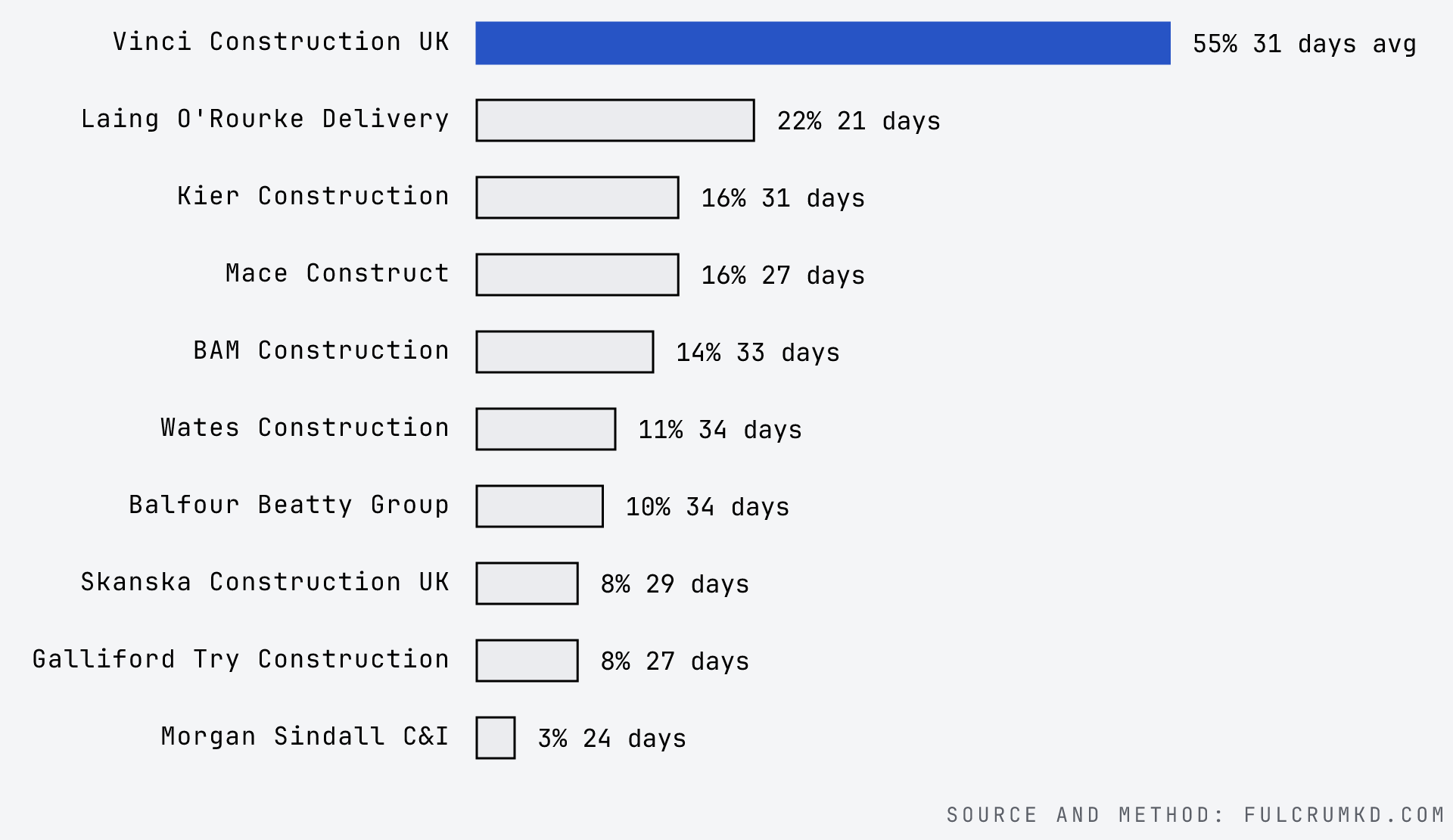
The table lists the construction entity of ten well-known UK main contractors, ranked by the share of invoices each reports as not paid within the agreed period. Each link goes to the filing.
One comparison sets the spread. Vinci Construction UK Limited reports 55% of invoices paid later than agreed; 94% of the 1,496 construction filers report a lower figure. Its average time to pay, 31 days, is the median exactly. The two numbers measure different things: the filing lists standard terms from 7 to 60 days, and a short term makes an invoice late sooner. Morgan Sindall Construction & Infrastructure Ltd reports 3% late on terms of 30 to 60 days.
Four more names have a current filing. Willmott Dixon Construction Limited: 28 days, 8% late, to 30 June 2026 (https://check-payment-practices.service.gov.uk/report/116840/). Bouygues (U.K.) Limited: 23 days, 16%, to 30 June 2026 (https://check-payment-practices.service.gov.uk/report/115054/). Sir Robert McAlpine Limited: 27 days, 5%, to 30 April 2026 (https://check-payment-practices.service.gov.uk/report/112061/). Keltbray Built Environment Limited: 45 days, 34%, to 30 April 2026, with 34% of invoices paid after day 60 (https://check-payment-practices.service.gov.uk/report/112144/). No ISG entity has a filing in the construction subset of the snapshot.
Groups file per company and the figures differ inside a group. Laing O'Rourke Services Limited reports 35 days and 50% late for the same period in which Laing O'Rourke Delivery Limited reports 21 days and 22% (https://check-payment-practices.service.gov.uk/report/111585/); Kier Services Limited reports 38 days and 40% against Kier Construction Limited's 31 days and 16% (https://check-payment-practices.service.gov.uk/report/115281/). The entity on your subcontract is the one whose filing applies.
- Vinci Construction UK Limited: average 31 days to pay, 55% of invoices paid later than agreed, 63% paid within 30 days, period to 30 Jun 2026. Filing: https://check-payment-practices.service.gov.uk/report/115462/
- Laing O'Rourke Delivery Limited: average 21 days to pay, 22% of invoices paid later than agreed, 69% paid within 30 days, period to 31 Mar 2026. Filing: https://check-payment-practices.service.gov.uk/report/111568/
- Kier Construction Limited: average 31 days to pay, 16% of invoices paid later than agreed, 45% paid within 30 days, period to 30 Jun 2026. Filing: https://check-payment-practices.service.gov.uk/report/115248/
- Mace Construct Limited: average 27 days to pay, 16% of invoices paid later than agreed, 82% paid within 30 days, period to 30 Jun 2026. Filing: https://check-payment-practices.service.gov.uk/report/115504/
- BAM Construction Limited: average 33 days to pay, 14% of invoices paid later than agreed, 65% paid within 30 days, period to 30 Jun 2026. Filing: https://check-payment-practices.service.gov.uk/report/114427/
- Wates Construction Limited: average 34 days to pay, 11% of invoices paid later than agreed, 64% paid within 30 days, period to 30 Jun 2026. Filing: https://check-payment-practices.service.gov.uk/report/115219/
- Balfour Beatty Group Limited: average 34 days to pay, 10% of invoices paid later than agreed, 72% paid within 30 days, period to 30 Jun 2026. Filing: https://check-payment-practices.service.gov.uk/report/115471/
- Skanska Construction UK Limited: average 29 days to pay, 8% of invoices paid later than agreed, 69% paid within 30 days, period to 30 Jun 2026. Filing: https://check-payment-practices.service.gov.uk/report/113143/
- Galliford Try Construction Limited: average 27 days to pay, 8% of invoices paid later than agreed, 60% paid within 30 days, period to 30 Jun 2026. Filing: https://check-payment-practices.service.gov.uk/report/114796/
- Morgan Sindall Construction & Infrastructure Ltd: average 24 days to pay, 3% of invoices paid later than agreed, 73% paid within 30 days, period to 30 Jun 2026. Filing: https://check-payment-practices.service.gov.uk/report/112726/
Ten main contractors: share of invoices paid later than agreed
What the figures mean when you price that contractor's work
The number that costs a subcontractor money is the count of days between a valid application and cash, and the register gives the inputs: the agreed term in the standard-terms note, the average time to pay, and the share paid later than agreed. A contractor filing 60-day terms with 20% late will, on its own figures, pay one application in five after day 60. On a £40,000 monthly account that is finance cost carried for the contractor; the late-payment interest calculator at /get-paid works out what statutory interest and compensation on such a delay come to.
To check the contractor in front of you, the contractor payment lookup at /get-paid/contractors takes a name or company number and shows that company's latest filing: average days, the three payment bands, the share paid late, its own note on standard terms and, for financial years from April 2025, its retention disclosure. The lookup reproduces the filing and links to it; it does not score anyone.
What the register is, and where it stops
The reports are made under the Reporting on Payment Practices and Performance Regulations 2017 (https://www.legislation.gov.uk/uksi/2017/395/made). Regulation 5 makes a company a qualifying company when it exceeds two or all three of the Companies Act 2006 size thresholds, which government guidance puts, from 6 April 2025, at £54 million turnover, £27 million balance sheet total and 250 employees (https://www.gov.uk/government/publications/business-payment-practices-and-performance-reporting-requirements). A qualifying company reports twice a year, within 30 days of the end of each period, and a named director must approve the report. Retention disclosure for construction contracts applies to financial years beginning on or after 1 April 2025; 815 of the 1,496 construction filers declare retention clauses.
Four limits apply. Only large payers file, so a missing name proves nothing. The figures are self-reported and the service does not audit them. "Late" means later than the agreed period, so a company on 90-day terms that pays on day 89 counts as on time and one on 7-day terms that pays on day 10 counts as late. An average hides the tail: Kier Construction Limited and Vinci Construction UK Limited both report 31 days, and Kier pays 3% of invoices after day 60 while Vinci pays 13%. Only the payment bands show which is which.
The public-sector clock
Section 68 of the Procurement Act 2023 implies into every public contract a term that sums due are paid within 30 days of the contracting authority receiving the invoice, or of the invoice due date if later, unless the authority considers the invoice invalid or disputes it and notifies the payee without undue delay. Section 73 implies the same terms into every public sub-contract, with the paying party read as the person to whom the works are supplied (https://www.legislation.gov.uk/ukpga/2023/54/section/73). The parties may agree earlier payment but may not restrict the implied term. Concession contracts, utilities contracts awarded by a private utility and contracts awarded by a school are excluded.
For central government work there is a bid-stage test as well. Procurement Policy Note 018 applies to central government departments, executive agencies and non-departmental public bodies, on contracts expected to exceed £5 million a year including VAT, advertised on or after 1 October 2025, when it replaced PPN 015 (https://www.gov.uk/government/publications/ppn-018-how-to-take-account-of-a-suppliers-approach-to-payment-in-the-procurement-of-major-contracts/ppn-018-taking-account-of-a-suppliers-approach-to-payment-in-the-procurement-of-major-contracts-html). A supplier must show it pays at least 95% of invoices within 60 days (90% with an action plan) and its invoices within an average of 45 days. The PPN does not tie its test to the register, but the register reports the same two measures: all ten contractors in the table report an average under 45 days, and adding each filing's two bands to day 60 gives 90% or more for nine of them and 87% for Vinci Construction UK Limited.
Common questions
- Does a high "paid later than agreed" percentage mean the contractor will pay me late?
- It is the share of all invoices due in the period, from every supplier, not paid by the agreed date. It does not say by how many days or how much money. Read it with the average time to pay, the payment bands and the company's note on its standard terms.
- Why is my main contractor not in the register?
- Only companies that exceed two of the three size thresholds (£54 million turnover, £27 million balance sheet total, 250 employees) must report, and not in their first financial year. Groups file per company, so search by the company number on your subcontract.
- Can I charge interest when a main contractor pays after the agreed date?
- The Late Payment of Commercial Debts (Interest) Act 1998 implies statutory interest and fixed compensation into most business-to-business contracts that lack a substantial remedy of their own (https://www.legislation.gov.uk/ukpga/1998/20/contents). Whether it applies and how much is due depends on the terms and the dates; the late-payment interest calculator at /get-paid shows the arithmetic and the guide on the late-payment interest rate covers the rules. This is not legal advice.
Written with AI assistance and edited by a human before publication. Not legal advice.
// read next
- Late payment interest rate UK: how the 8% over base rule works, and why the date matters
UK late payment interest is 11.75% for business invoices due from 1 July 2026. How it is set, the £40/£70/£100 fixed sums, and a worked example on £18,400.
- Pay less notice: what it must say and when it must arrive
What a pay less notice must contain under s.111 of the Construction Act, the deadline (contract or 7 days before the final date), and what happens if it's late.
- Retention in construction: how to get it back
Retention in construction is contractual, so your subcontract dates decide when to chase. Steps, a plain release email, and what to do when they go quiet.