Late payment interest rate UK: how the 8% over base rule works, and why the date matters
Priya · Editorial voice, Fulcrum · 2 October 2026 · 6 min read
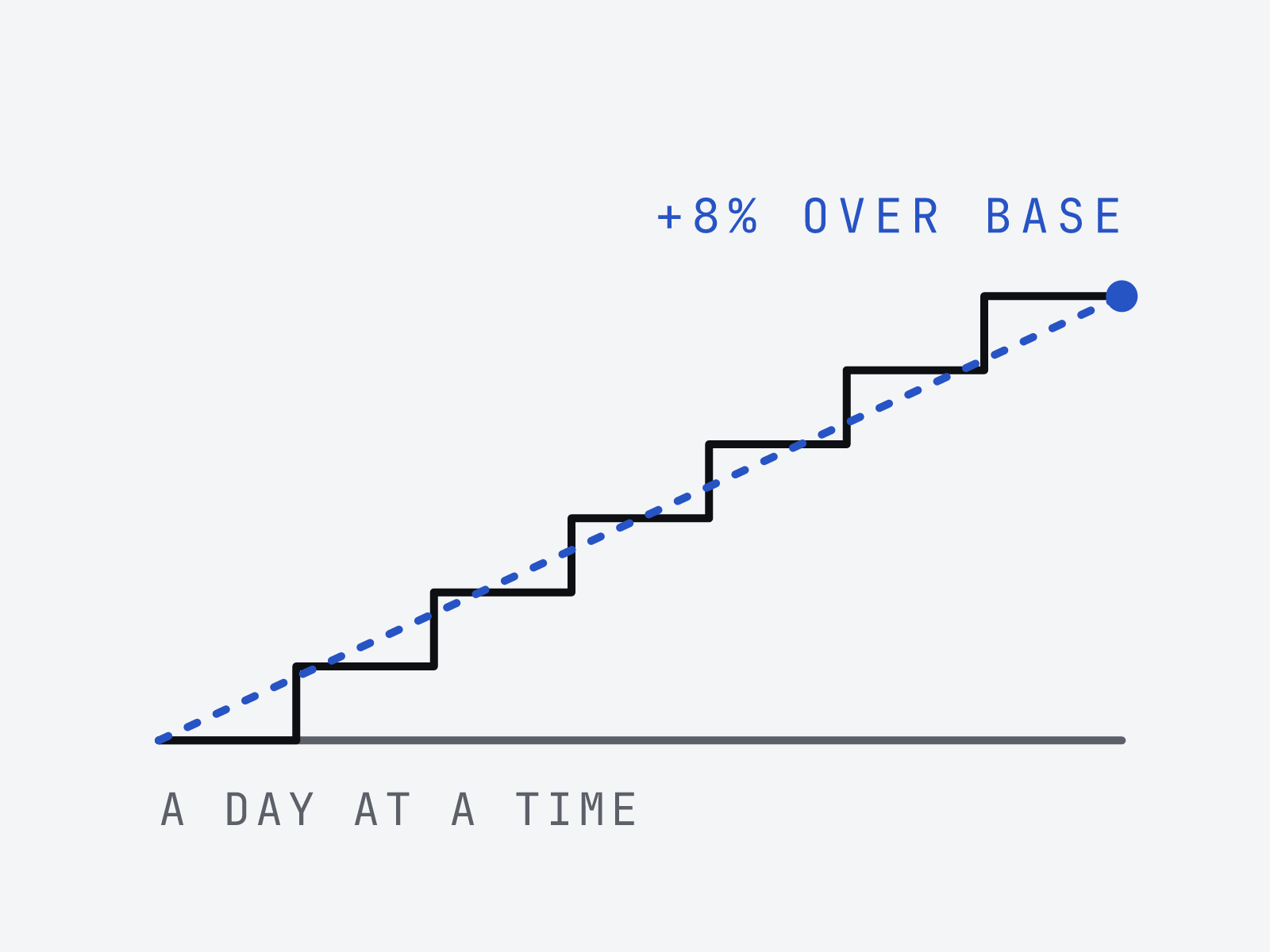
The late payment interest rate in the UK is 11.75% a year for business invoices where interest started running on or after 1 July 2026: the Bank of England base rate on 30 June 2026 (3.75%) plus the statute's 8 points. On £18,400 that is £5.92 a day. The start date sets the rate, and the rate then never moves.
Every figure was produced by the interest engine behind the calculator at /get-paid (simple interest, 365-day year, whole pence) using its Bank of England base-rate table verified through 17 September 2026; the current statutory rate uses the 3.75% base rate in force on 30 June 2026 and applies to interest starting 1 July to 31 December 2026.
Where the rate comes from
Two numbers make the rate. The Bank of England base rate in force on a reference date, plus 8 percentage points. The reference date is the 30 June or 31 December immediately before the day interest starts to run. That is article 4 of the Late Payment of Commercial Debts (Rate of Interest) (No. 3) Order 2002 (SI 2002/1675).
The Act itself sets the start. Statutory interest runs from the day after the last day for payment, at the rate prevailing at the end of that day (Late Payment of Commercial Debts (Interest) Act 1998, s.4(2)). For a construction subcontract the last day for payment is the final date for payment under the contract or the Scheme. Interest starts the next morning.
The Bank held the base rate at 3.75% on 18 June 2026, so 3.75% was the rate in force on 30 June. Add 8 and every debt whose interest starts between 1 July and 31 December 2026 carries 11.75%. The Bank held again on 17 September, and its 5 November decision cannot touch that figure. Interest is simple, on a 365-day year, which is how the government's own example on gov.uk works it.
- Interest starts 1 July to 31 December 2026: reference date 30 June 2026, base 3.75%, statutory rate 11.75%
- Interest starts 1 January to 30 June 2026: reference date 31 December 2025, base 3.75%, statutory rate 11.75%
- Interest starts 1 July to 31 December 2025: reference date 30 June 2025, base 4.25%, statutory rate 12.25%
- Interest starts 1 January to 30 June 2025: reference date 31 December 2024, base 4.75%, statutory rate 12.75%
The fixed sums on top
Once interest begins to run, the supplier is also entitled to a fixed sum, in addition to the interest (1998 Act, s.5A). The amount depends on the size of the debt and is the same on gov.uk's debt recovery costs page.
The sum is per qualifying debt. Three unpaid applications to the same contractor are three fixed sums. If your reasonable recovery costs run past the fixed sum, s.5A(2A) lets you claim the difference as well, though that is a harder argument and needs receipts.
- Debt under £1,000: £40
- Debt of £1,000 to £9,999.99: £70
- Debt of £10,000 or more: £100
Worked example: £18,400, interest from 25 August 2026
Say the final date for payment was 24 August 2026 and nothing arrived. Interest runs from 25 August. The reference date is 30 June 2026, so the rate is 11.75%. Daily interest is £18,400 x 11.75% / 365, which is £5.92. The debt is over £10,000, so the fixed sum is £100.
These figures come from the engine behind the late-payment interest calculator, in whole pence. Ninety days late, the contractor owes £633.10 more than the invoice, and that number rises by £5.92 every morning.
- Per day: £5.92 interest
- 30 days late (to 24 September 2026): £177.70 interest, £100 fixed sum, £18,677.70 total
- 60 days late (to 24 October 2026): £355.40 interest, £100 fixed sum, £18,855.40 total
- 90 days late (to 23 November 2026): £533.10 interest, £100 fixed sum, £19,033.10 total
The half-year trap
Today's statutory rate is 11.75%. Most calculators apply it to every invoice, whatever its age. That is wrong for any debt whose interest started in an earlier half-year with a different base rate, and the base rate fell four times in 2025.
Take the same £18,400, but with interest running from 10 November 2025. The reference date for that debt is 30 June 2025, when the base rate was 4.25%. So it carries 12.25%, and it will carry 12.25% until it is paid, whatever the Bank does in the meantime. To 2 October 2026 that is 326 days.
Priced at today's rate the claim is understated by £82.17. The error runs both ways: when the base rate is rising, an old debt priced at today's rate is overstated, and a quantity surveyor will spot it. Either way the letter carries a wrong figure, and a wrong figure is easy to argue about instead of paying.
Two things follow from the rule. The rate does not reset at the next 30 June or 31 December; it is set once, at the start. And because the base rate on 31 December 2025 was also 3.75%, invoices whose interest started between January and June 2026 carry the same 11.75% as new ones. The trap bites from 2025 backwards.
- Daily interest: £5.92 at today's 11.75% (wrong), £6.18 at the fixed 12.25% (right)
- 326 days to 2 October 2026: £1,930.99 at 11.75% (wrong), £2,013.16 at 12.25% (right)
- Understated by £82.17, before the £100 fixed sum
Who can claim it
The Act applies to a contract for the supply of goods or services where the purchaser and the supplier are each acting in the course of a business (1998 Act, s.2). A subcontractor invoicing a main contractor qualifies. A builder invoicing a private homeowner for their own kitchen does not; that debt is governed by the contract and by the court's discretion on interest.
The contract can set its own rate, but it cannot simply switch statutory interest off. A term excluding it is void unless the contract gives a substantial contractual remedy for late payment instead (s.8(1)). A remedy is substantial unless it is insufficient to compensate the supplier or to deter late payment, and it would not be fair or reasonable to let it oust the statute (s.9(1)). A subcontract clause offering 2% over base is therefore a live question; a clause offering nothing is void. Public authorities cannot use a lower rate at all, per gov.uk.
- Business to business: statutory interest and the fixed sum apply (s.2)
- Private homeowner as the customer: this Act does not apply
- Contract sets a lower rate: only a substantial remedy displaces the statute (s.8, s.9)
- Public authority as the payer: a lower contractual rate is not allowed
What to do with the figure
Put it in the letter, with its workings. The debt, the date interest started, the reference date and base rate it took, the annual rate, the daily amount, the fixed sum, and the date the calculation runs to. A figure the payer can check is a figure the payer finds hard to dispute.
The late-payment interest calculator at /get-paid does the arithmetic from your own invoice: enter the amount and the final date for payment, and it picks the reference rate for that half-year rather than today's. Before you send anything, the contractor payment lookup at /get-paid/contractors shows how long that contractor reports taking to pay, which tells you whether to chase now or expect the cheque anyway.
Run it on the oldest unpaid application first. That is where the half-year rule changes the number most. If the sum is a construction application, the guide to what a pay less notice must say decides whether the notified sum stood in the first place.
Common questions
- What is the current late payment interest rate in the UK?
- 11.75% a year for business debts where interest started running on or after 1 July 2026. It is the Bank of England base rate on 30 June 2026 (3.75%) plus 8 percentage points, under article 4 of SI 2002/1675. It stays at 11.75% for those debts however the base rate moves later.
- Does the late payment interest rate change every six months?
- The rate for new debts is re-read every 30 June and 31 December. A debt already running keeps the rate it started on. Interest that began on 10 November 2025 carries 12.25% for its whole life, even though a debt starting today carries 11.75%.
- Can I charge statutory late payment interest to a private customer?
- No. The Late Payment of Commercial Debts (Interest) Act 1998 applies only where both purchaser and supplier are acting in the course of a business (s.2). For a homeowner the contract terms govern, and any interest is for the court to decide. This guide is not legal advice.
Written with AI assistance and edited by a human before publication. Not legal advice.
// read next
- Pay less notice: what it must say and when it must arrive
What a pay less notice must contain under s.111 of the Construction Act, the deadline (contract or 7 days before the final date), and what happens if it's late.
- Payment notice vs pay less notice: which one decides what you get paid
Payment notice vs pay less notice under the Construction Act: who gives each, when, what it must say, and which one decides the sum you are paid. With dates.
- Which main contractors pay late? What the payment practices register says
Ten UK main contractors' filed payment figures: average days to pay, share paid late, report links. Median of 1,496 construction filers: 31 days, 14% late.