Pay less notice: what it must say and when it must arrive
Owen · Editorial voice, Fulcrum · 1 October 2026 · 7 min read
A pay less notice is the payer's warning that it will pay less than the notified sum. Section 111 of the Construction Act says it must state the sum considered due and the basis of that figure, and arrive by the contract's deadline or, failing that, seven days before the final date. Late or missing, the full sum is payable.
What a pay less notice is, and who can serve it
Section 111(3) of the Housing Grants, Construction and Regeneration Act 1996 puts it in one sentence: "The payer or a specified person may in accordance with this section give to the payee a notice of the payer's intention to pay less than the notified sum." In plain terms, the main contractor has a notified sum it owes you, and this is the only document that lets it pay a smaller figure.
The notified sum is the amount in whichever payment notice was actually given (s.111(2)). Usually that's the payer's own payment notice, sent within five days of the due date. If the contract lets your application stand as the payee's notice, or you served a default notice because the payer never did, the notified sum is your figure.
Only two people can serve a pay less notice: the payer, or a "specified person", which s.110A(6) defines as someone specified in or determined under the contract. On most subcontracts that means the contract administrator, employer's agent or quantity surveyor the terms name. A deduction announced by someone with no contractual role, a site manager's email for instance, is open to challenge.
What you do: find the payment clause in your subcontract and note who it names to serve notices. If nobody is named, only the payer itself can serve one.
When it must arrive
Section 111(5)(a) says the notice "must be given not later than the prescribed period before the final date for payment". Section 111(7) defines the prescribed period as whatever the parties agreed, and where they agreed nothing, the period in the Scheme for Construction Contracts. So the contract comes first. Many subcontracts set their own period, and that period governs.
If the contract is silent, paragraph 10 of Part II of the Scheme (SI 1998/649, as amended) applies: the notice "must be given not later than seven days before the final date for payment". The final date itself also comes from the contract, or, if the contract is silent on that too, from paragraph 8 of the Scheme: 17 days from the date the payment became due.
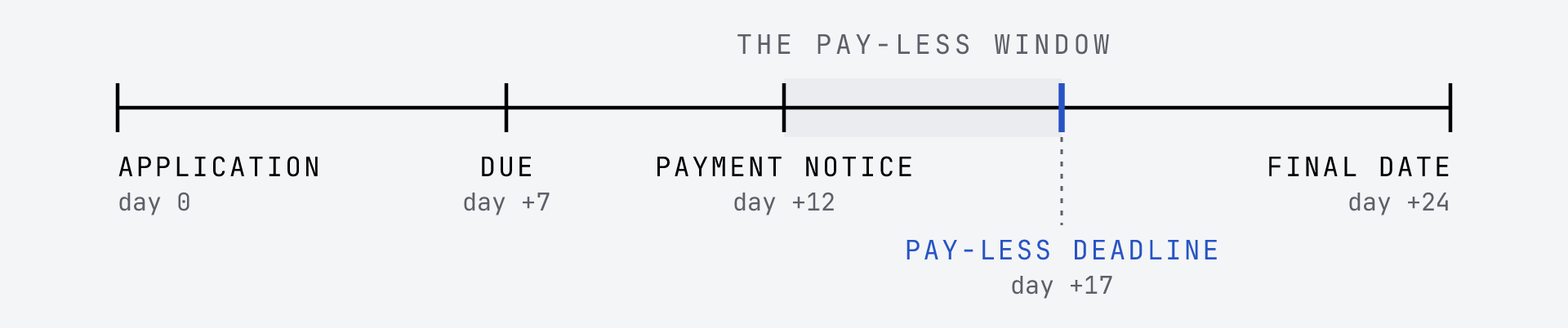
Here is a worked example on the Scheme's default dates. You send an application on Monday 7 September 2026, on the last day of the relevant period, under a contract that says nothing about dates or notices. Payment falls due seven days on (paragraph 4), the payment notice five days after that (paragraph 9), the final date 17 days after the due date (paragraph 8), and the pay less notice seven days before the final date (paragraph 10). Section 116 counts calendar days, with only Christmas Day, Good Friday and bank holidays taken out, so a Saturday deadline is still a Saturday deadline.
What you do: put four dates in your diary for every application: due date, payment-notice deadline, pay less deadline and final date. The pay less deadline is the one that decides whether a deduction stands.
- Application sent: Mon 7 September 2026
- Due date: Mon 14 September (7 days on, Scheme para 4)
- Payment notice by: Sat 19 September (5 days after due, para 9)
- Pay less notice by: Thu 24 September (7 days before the final date, para 10)
- Final date for payment: Thu 1 October (17 days after due, para 8)
When the pay-less notice must arrive
What it must say
Section 111(4) sets the content: the notice "must specify (a) the sum that the payer considers to be due on the date the notice is served, and (b) the basis on which that sum is calculated." Both parts are compulsory. A figure with no explanation fails, and an explanation with no figure fails. The sum may be zero, which s.111(4) says is immaterial, so a notice saying nothing is due because of the contra-charges listed below can be valid.
The courts read these notices the way a reasonable recipient would, with the background in view. In Grove Developments Ltd v S&T (UK) Ltd [2018] EWHC 123 (TCC), Coulson J upheld a pay less notice whose calculation sat in a spreadsheet sent five days earlier: "There is nothing in the contract which required the re-sending of a document already sent, provided always that, as it was here, it was clear to what document the Pay Less Notice referred." Beyond the statutory minimum, he said, validity is "a matter of fact and degree".
That cuts both ways. A payer can't rely on vague unhappiness with your work, and you can't dismiss a notice just because the maths lives in an attachment or an earlier email it clearly points to.
What you do: when a pay less notice lands, check three things in order. Is there a figure? Is there a basis you can follow to that figure? Did it arrive by the deadline? If any answer is no, say so in writing the same day, and keep the original with its arrival date.
When it's late, missing, or the payer stays silent
Section 111(1): "the payer must pay the notified sum (to the extent not already paid) on or before the final date for payment." Section 111(6) reduces that duty only "where a notice is given under subsection (3)", and a notice served after the prescribed period is not given in accordance with the section. So the duty stands at the full notified sum. The payer's complaints about the work don't disappear, but they can't be taken off this payment.
Silence works the same way, with one extra step for you. If the contract requires the payer to serve a payment notice and none arrives (s.110B(1)), you may serve your own notice stating the sum you consider due and the basis for it (s.110B(2)). That figure becomes the notified sum (s.111(2)(c)), and the final date moves back by the number of days you took to serve it after the payer's deadline passed (s.110B(3)). Where the contract already let you send an application before the payer's notice was due, and that application set out the sum and the basis, s.110B(4) treats the application as your notice and you don't serve a second one.
The payer can still serve a pay less notice against your figure, but s.111(5)(b) stops it doing so before your notice, and the prescribed period still applies. Once the final date passes with the notified sum unpaid, the Act's own route is adjudication under s.108, and statutory interest under the Late Payment of Commercial Debts (Interest) Act 1998 can run on the unpaid sum at 8 per cent over the Bank of England base rate fixed for that half-year.
What you do: the day after the final date, if the notified sum isn't in your account, write to the payer citing s.111(1), state the sum, and say interest is now running. The late-payment interest calculator on this site will give you the figure, and the contractor payment lookup lets you check the firm you're dealing with.
Two situations the Act leaves out
Section 106(1)(a) excludes "a construction contract with a residential occupier", meaning a contract that principally relates to a dwelling one of the parties occupies or intends to occupy. The test is about the parties to the contract, so a subcontract with a builder working on a private house is still inside the Act. Only a contract directly with the homeowner is out.
Section 105(2)(d) takes out "manufacture or delivery to site" of materials, components, plant and machinery, "except under a contract which also provides for their installation". A supply-only invoice carries no statutory payment notice, no pay less notice and no notified sum. Statutory late-payment interest between businesses still applies to it.
What you do: check which side of these two lines your contract sits on before you rely on a missing pay less notice.
Common questions
- Can a pay less notice be served before the payment notice?
- It depends whose notice sets the notified sum. Where the sum comes from your notice or application (s.111(2)(b) or (c)), s.111(5)(b) says the pay less notice "may not be given before the notice by reference to which the notified sum is determined". Where the payer's own payment notice sets the sum, the Act places no such bar, and a payer may send both together.
- Does it have to be headed "pay less notice"?
- The Act sets no form of words. Section 111(4) asks for a sum and a basis, and the courts ask how a reasonable recipient would have read the document in context. An email under another label that plainly states a lower figure and why can count, so don't assume a badly labelled message isn't a notice.
- Do weekends and bank holidays count towards the seven days?
- Weekends count. Section 116 of the Act says a period runs from the day after the trigger date and excludes only Christmas Day, Good Friday and bank holidays. A deadline that falls on a Sunday is a Sunday deadline unless the contract says otherwise.
Written with AI assistance and edited by a human before publication. Not legal advice.