Payment notice vs pay less notice: which one decides what you get paid
Owen · Editorial voice, Fulcrum · 2 October 2026 · 6 min read
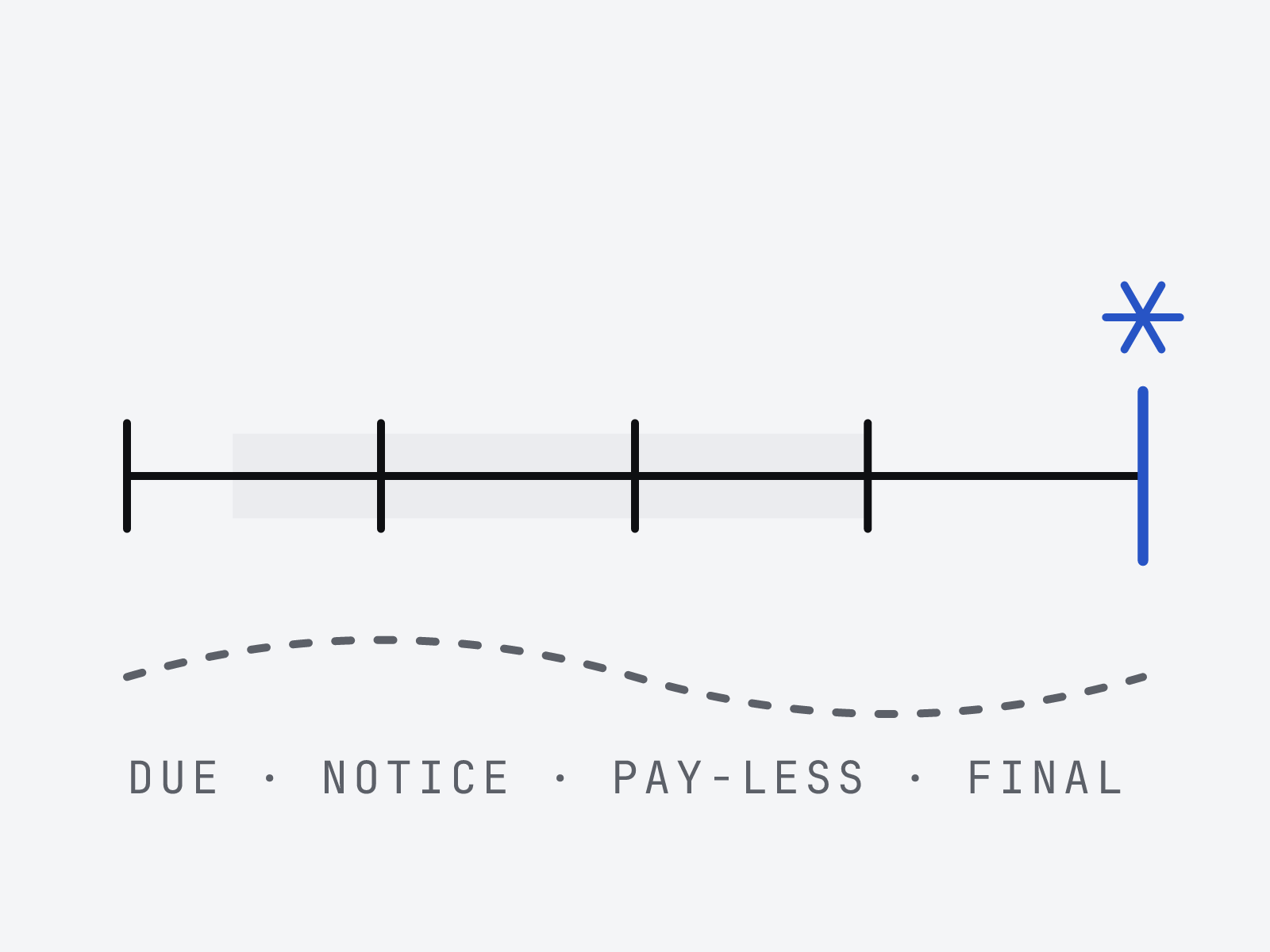
Payment notice vs pay less notice comes down to one line in the Construction Act: the payment notice fixes the notified sum, and the pay less notice is the payer's only lawful way to reduce it. If the payment notice is missing, you can serve your own. If the pay less notice is late, it has no effect.
The payment notice sets the notified sum
Section 110A of the Housing Grants, Construction and Regeneration Act 1996 requires a payment notice on every payment. The contract chooses who gives it: the payer, a person the contract names, or the payee. Whoever gives it, the deadline is five days after the payment due date.
It must state the sum the giver considers due at the due date and the basis of that calculation. A figure with no workings does not qualify. A notice for zero does, because section 110A(4) says a zero sum is immaterial.
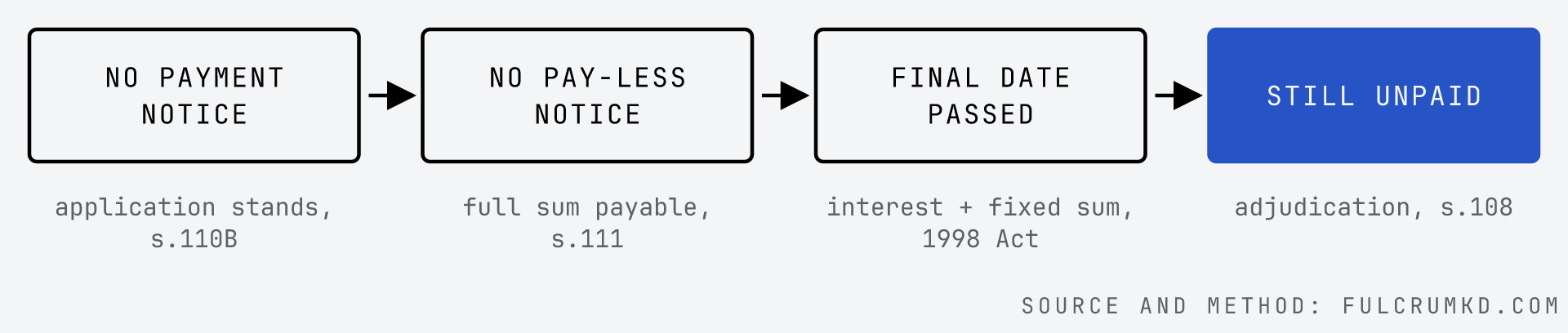
Section 111(1) then gives that figure its force: "the payer must pay the notified sum (to the extent not already paid) on or before the final date for payment." Section 111(2) defines the notified sum as the amount in whichever valid notice was given: the payer's, the payee's under the contract, or the payee's default notice under section 110B.
So the payment notice is the number the cycle runs on. If it says £48,000, the payer owes £48,000 on the final date unless a valid pay less notice changes it.
The pay less notice cuts that sum down
Section 111(3) lets the payer, or the person the contract names, give a notice of intention to pay less than the notified sum. The payee cannot give one. Under section 111(4) it states the sum the payer considers due on the date it is served, and the basis of that calculation. Zero is allowed here too.
Section 111(5) sets the timing: not later than the prescribed period before the final date for payment. The prescribed period is whatever the contract says; where the contract is silent, paragraph 10 of the Scheme for Construction Contracts supplies seven days.
Section 111(6) gives the effect: where a pay less notice is given, the duty to pay applies only to the sum in it. Where none is given, the full notified sum stays payable.
A pay less notice works if it is in time and shows its working. The figure can be argued later in adjudication; on the final date, the notice decides what is payable.
The two notices at a glance
Same six rows for each notice.
- Who gives it: payment notice, the payer, a specified person or the payee, as the contract decides. Pay less notice, the payer or specified person only.
- When: payment notice, not later than five days after the due date. Pay less notice, not later than the prescribed period before the final date, seven days under the Scheme.
- What it must say: payment notice, the sum due at the due date and the basis of calculation. Pay less notice, the sum due on the date it is served and the basis of calculation.
- What it does: payment notice, fixes the notified sum. Pay less notice, replaces the notified sum with a lower figure for that payment.
- If it is missing: payment notice, the payee may serve a default notice under section 110B and that becomes the notified sum. Pay less notice, the full notified sum is payable on the final date.
- Section: payment notice, 110A and 110B. Pay less notice, 111.
The one mistake people make
It comes in two halves, and both hand the payer a discount the Act never gave them.
The first half is on the payee side. The payer sends no payment notice and the subcontractor waits, reading the silence as a dispute. Section 110B(2) says otherwise: where the payer was required to give the notice and did not, the payee may give one at any time after the payer's deadline. Some contracts treat the application itself as that notice under section 110B(4). If yours does not, serve your own. The only cost, under section 110B(3), is that the final date moves back by the number of days you were late.
The second half is on the payer side. A pay less notice arrives after the deadline, and the subcontractor treats it as a reduction. In law it is a letter. Section 111(6) attaches only to a notice given in accordance with section 111, and a late one is outside it.
The courts hold this line. In LAPP Industries Ltd v 1st Formations Ltd [2025] EWHC 943 (TCC), an application for £120,000 stood as the default payment notice, neither notice followed, and the Technology and Construction Court enforced the adjudicator's award of the full sum. In S&T (UK) Ltd v Grove Developments Ltd [2018] EWCA Civ 2448, the Court of Appeal held that a payer who has missed its notices must pay the notified sum before it can adjudicate the true value of the work, because adjudication is subordinate to section 111 (paragraphs 107 and 108).
So a missing payment notice is an invitation to serve your own, and a late pay less notice changes nothing about what is due. To see how a main contractor has paid other firms, the contractor payment lookup is free.
What happens when they miss the dates
One application, five dates
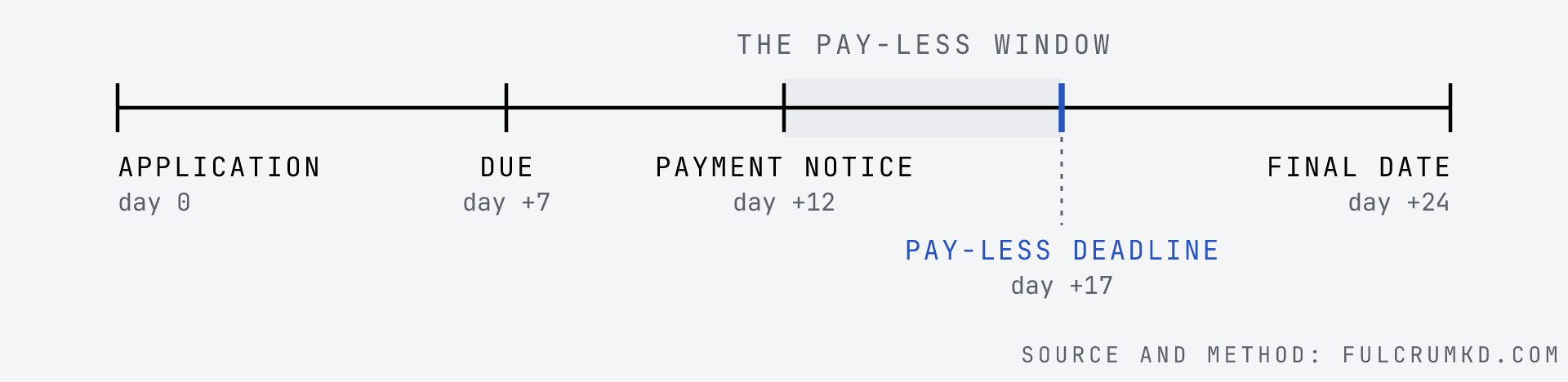
Take a contract with no payment terms of its own, so the Scheme fills the gaps, and an application sent on Monday 7 September 2026, treated as both the end of the relevant period and the claim.
The payment notice deadline falls on a Saturday and stays there: section 116 excludes only Christmas Day, Good Friday and bank holidays from the count. The pay less deadline is counted back from the final date, so longer payment terms push it later while the payment notice deadline stays put.
Now suppose nothing arrives by 19 September and you serve a default notice on Monday 21 September. Section 110B(3) postpones the final date by the two days you were late, to Saturday 3 October, and the pay less deadline moves to Saturday 26 September. If 3 October passes unpaid, the late-payment interest calculator shows what the delay is worth.
- Application sent: Monday 7 September.
- Payment due date: Monday 14 September, seven days after the relevant period (Scheme paragraph 4).
- Payment notice deadline: Saturday 19 September, five days after the due date (section 110A(1) and Scheme paragraph 9).
- Pay less notice deadline: Thursday 24 September, seven days before the final date (Scheme paragraph 10).
- Final date for payment: Thursday 1 October, seventeen days after the due date (Scheme paragraph 8).
The Scheme dates from one application
Common questions
- Can my application count as the payment notice?
- Yes, in two situations. The contract can make the payee's notice the payment notice under section 110A(1)(b). Or it can let you notify the sum before the payer's deadline, and section 110B(4) then treats that as your default notice if the payer stays silent. Otherwise, serve a separate default notice under section 110B(2).
- Does a late pay less notice reduce the sum at all?
- No. Section 111(6) only bites where the notice was given in accordance with section 111, and the timing rule in section 111(5) is part of that. The payer's route is to pay the notified sum and then adjudicate the true value, as S&T v Grove requires.
- What if the payer simply pays late?
- Interest runs from the day after the final date. Where the contract has no adequate interest term, the Late Payment of Commercial Debts (Interest) Act 1998 implies one at eight per cent over the Bank of England base rate, fixed for each half year, plus a fixed recovery sum per debt. Enter the dates into the late-payment interest calculator to see the figure.
Written with AI assistance and edited by a human before publication. Not legal advice.
// read next
- Pay less notice: what it must say and when it must arrive
What a pay less notice must contain under s.111 of the Construction Act, the deadline (contract or 7 days before the final date), and what happens if it's late.
- Late payment interest rate UK: how the 8% over base rule works, and why the date matters
UK late payment interest is 11.75% for business invoices due from 1 July 2026. How it is set, the £40/£70/£100 fixed sums, and a worked example on £18,400.
- Which main contractors pay late? What the payment practices register says
Ten UK main contractors' filed payment figures: average days to pay, share paid late, report links. Median of 1,496 construction filers: 31 days, 14% late.