Terms of service for an AI-built app under UK law, clause by clause
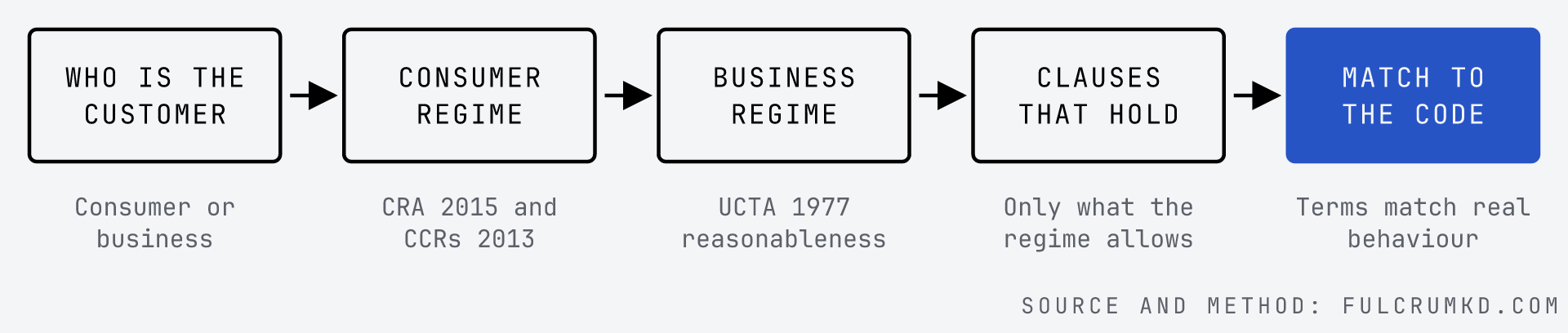
A terms of service page for an app you built with AI has to do three things under UK law. Say who the customer is, a consumer or a business, because different rules apply. Describe only what the app actually does. Exclude only what the law lets you exclude, which for consumers is far less than copied templates assume.
In this article 5 sections
Why a generated or copied terms page is a risk
Most terms pages on AI-built apps were written the same way as the app: a prompt, a template, a paste. The page looks complete. The trouble is that it describes a different business. It promises support hours nobody staffs, an uptime figure nobody measures, and a refund process the code cannot run. Under section 50 of the Consumer Rights Act 2015, anything written to a consumer about the service becomes a term of the contract if they took it into account. A copied promise is still a promise.
The second problem runs the other way. Templates written for US software companies exclude everything: all warranties, all liability, all responsibility for what the product does. In the UK, a term that tries to exclude liability for digital content being of satisfactory quality, fit for purpose or as described is simply not binding on a consumer (section 47 of the same Act). Section 57 does the same job for services. The clause gives no protection. It falls away, and the statutory default applies in its place.
There is a third cost, which is regulatory. The Competition and Markets Authority's guidance on unfair terms (CMA37, updated 22 July 2026) says an unfair or prohibited term is not binding, that a trader may have to repay money taken under it, and that the CMA can impose a penalty of up to 10% of global turnover or £300,000, whichever is greater. That power sits beside the ban on unfair commercial practices in section 225 of the Digital Markets, Competition and Consumers Act 2024, in force since 6 April 2025. An honest, short page carries none of that risk. A copied one can.
Consumer or business customer: decide before you write a clause
The 2015 Act defines a consumer as an individual acting for purposes wholly or mainly outside their trade, business, craft or profession (section 2). If you claim a user was acting as a business, you have to prove it. So a productivity app sold to individuals is a consumer contract, even when some of those individuals use it for work. A tool sold to companies, invoiced to a company name, is a business contract. Many AI-built apps do both, and the terms have to say which rules apply to which customer.
For consumers, the rules come from the Consumer Rights Act 2015 and the Consumer Contracts Regulations 2013. Digital content must be of satisfactory quality (section 34), fit for any purpose you were told about (section 35) and as described (section 36). Services must be performed with reasonable care and skill (section 49). Any term that excludes those duties, or restricts them so far that the consumer cannot recover the price paid, is not binding (sections 47 and 57). Above that sits the fairness test in section 62: a term causing a significant imbalance to the consumer's detriment, contrary to good faith, is not binding either.
For business customers, the Unfair Contract Terms Act 1977 applies instead. Where the customer signs up on your written standard terms, section 3 says you can only exclude or restrict liability for breach as far as the term satisfies the requirement of reasonableness. Section 11 sets the test: the term must have been fair and reasonable to include, given what both sides knew when the contract was made. For a cap, the court looks at the resources you had to meet the claim and how far you could have insured (section 11(4)). The burden of proving the term reasonable is on you (section 11(5)).
One rule sits above both regimes. Nobody can exclude or restrict liability for death or personal injury caused by their own negligence. For business contracts that is section 2(1) of the 1977 Act. For consumers it is section 65 of the 2015 Act, and Schedule 2 lists such a term first among those that may be regarded as unfair. Delete that line from any template you have used. It has no effect in the UK, and it signals that the rest of the page was written for another jurisdiction.
Which terms apply
The clauses that matter and what each has to say
A working terms page for a small app needs about ten clauses. Each one should describe what the app does today, in the present tense. Where you have not built something, say so or leave it out. The list below is the order most solicitors would use. The order matters less than the honesty of each line.
The limitation clause is where copied templates go most wrong. In business contracts, a cap tied to the fees paid in the preceding twelve months is common, and it can pass the reasonableness test provided it is visible, the customer could have negotiated or insured, and it does not empty the contract of meaning. Against consumers, the same cap will not hold where it prevents them recovering the price paid for content or a service that failed (sections 47(3) and 57(3)). Write the consumer version as a plain statement of what the law gives them, and put the cap in the business version only.
Two clauses lean on other documents. Data processing should point to a privacy policy that matches how the app really handles data. The privacy policy guide covers what that page has to contain, and the GDPR by country guide covers users outside the UK. Business customers will also expect a data processing agreement, which sets out what you do with their data and on whose instructions. Do not sign one that promises a deletion the code cannot perform.
The changes clause is the other. Schedule 2 of the 2015 Act lists, as a term that may be unfair, one that lets the trader alter the contract unilaterally without a valid reason specified in the contract. The CMA's guidance (paragraphs 6.46 and 6.47) says a variation term is more likely to be fair when it is narrow, states its reasons, gives notice before the change takes effect, and leaves the consumer able to escape it by cancelling. A line saying you may change these terms at any time fails all of those tests. Replace it with the reasons, the notice period and the exit.
- What the service is and is not: the features that exist, the ones in beta, the ones you have chosen not to promise.
- Acceptable use: what a user may not do, and what you will do about it.
- Accounts and termination: how a user closes an account, what happens to their data, and on what notice you can close it.
- Fees and refunds: the price, the billing period, what happens on non-payment, and the refund rule for each customer type.
- Uptime and support: only the hours and targets you actually staff and measure.
- Limitation of liability: one version for business customers, one for consumers.
- Intellectual property and user content: you own the app, they own what they upload, and the licence you need to run it.
- Data processing: a pointer to the privacy policy and, for business customers, a data processing agreement.
- Governing law and courts: England and Wales, Scotland or Northern Ireland, whichever you are in.
- Changes to terms: the valid reasons, the notice period, and the right to cancel.
The 14-day cancellation right and the digital content exception
Almost every app sold online to a consumer is a distance contract under the Consumer Contracts Regulations 2013: concluded without trader and consumer in the same room, using only remote means (regulation 5). That triggers a right to cancel within 14 days without giving a reason (regulation 29). For a service, or for digital content not supplied on a physical medium, the 14 days run from the day the contract is made (regulation 30). Business customers get no such right. It belongs to consumers only.
There are two ways a consumer can lose the right, and both need the app to do something specific at checkout. For a service that starts inside the 14 days, the consumer must have made an express request for it to start; if they later cancel, they pay a proportionate amount for what was supplied (regulation 36). For digital content, regulation 37 is stricter: supply may begin early only if the consumer gave express consent and acknowledged that the right to cancel will be lost. If either element is missing and they cancel, they owe nothing for the content.
The information duty has teeth. Schedule 2 to the Regulations requires you to tell the consumer, before they commit, the conditions and procedure for cancelling, when they lose the right, the duration of the contract, how to end an auto-renewing one, and the functionality and compatibility of the digital content. Miss the cancellation information and regulation 31 extends the 14 days by up to 12 months. That is the most common gap in generated terms: the checkout has a consent checkbox the terms never mention, or the terms describe a checkbox the checkout never shows.
Subscription apps have a further set of rules waiting. Chapter 2 of Part 4 of the Digital Markets, Competition and Consumers Act 2024 will require key pre-contract information, reminder notices before renewal payments, a straightforward way to end the contract, and a 14-day cooling-off period at the start and at each renewal (sections 256 to 265). As at 30 September 2026, legislation.gov.uk marks those sections as prospective, and the CMA's July 2026 guidance notes they are not yet in force. Write your terms so that switching them on later is a small change.
The practical route, this week and after
A short page in plain English beats a long copied one. The 2015 Act requires written consumer terms to be transparent, which the CMA reads as plain and intelligible language that a customer can read and understand. Length works against that. Write each clause as a statement of what the app does, check it against the code, and delete anything you cannot point to. If you sell to both consumers and businesses, publish two documents, or one document with two clearly labelled parts, and make the checkout pick the right one.
Pay a solicitor for a contract that matters. That means any business deal negotiated line by line, anything with an indemnity in it, anything where a customer's own lawyers have sent back a marked-up copy, and any cap that has to hold against a claim bigger than your annual revenue. A standard consumer page for a small app is something you can draft honestly yourself, then have reviewed once. The review costs less when the page is short and true.
What Fulcrum does sits on the other side of the page. The Code Health Check reads the app and compares its behaviour with what the terms and the privacy policy promise: whether account deletion deletes, whether the retention period in the policy matches the database, whether a cancelled subscription stops billing, whether the refund path the terms describe exists. Those mismatches are where a term you meant to keep becomes a term you cannot enforce. It sits alongside the four checks for a new AI-built app and the authorisation sweep; the hub piece maps the rest of the layer.
Common questions
- Can one terms page cover both consumers and businesses?
- Only if it says clearly which parts apply to whom. The consumer rules in the Consumer Rights Act 2015 cannot be excluded, and a cap that works in a business contract fails against a consumer if it stops them recovering the price paid. Two labelled parts, or two documents, is the cleaner route.
- Can I cap my liability at the fees the customer paid?
- For business customers on your standard terms, a cap tied to fees paid can pass the reasonableness test in section 11 of the Unfair Contract Terms Act 1977, where the court weighs your resources and insurance. For consumers, a cap that prevents recovery of the price paid is not binding (sections 47 and 57 of the 2015 Act).
- Do I have to refund a consumer who cancels a subscription within 14 days?
- Usually yes, unless the checkout did the right thing. If the consumer expressly asked for the service to start straight away, you may keep a proportionate amount for what was supplied (regulation 36). For digital content, you may keep the full amount only if they gave express consent and acknowledged the right to cancel would be lost (regulation 37).
- Is a terms page written by an AI tool legally valid?
- Who wrote a term makes no difference to whether it binds. Its content does. The risk with a generated page is that it describes a service you do not run and excludes liability you cannot exclude. Read it against the app, cut what is untrue, and remove the exclusions the law does not allow.
Written with AI assistance and edited by a human before publication.
// read next
- You shipped an app with AI and people use it. Here is the layer around it
Your AI-built app has real users. The six things that now sit around it: a penetration test, SOC 2, terms, a true privacy policy, GDPR by country, the basics.
- What a privacy policy for an AI-built app must say under UK GDPR
What UK GDPR Articles 13 and 14 make an app's privacy notice say, the ICO fee tiers, the 72-hour breach clock, and how to write it from what the code collects.
- GDPR by country: what changes when your AI-built app has users abroad
The law follows the user, not the server. What UK GDPR, EU GDPR and US state laws ask of a UK app with users abroad, and which transfer mechanism to name.