GDPR by country: what changes when your AI-built app has users abroad
Data protection law follows the user, not the server. A UK company with EU users is inside the EU GDPR as well as the UK GDPR, and may owe them a representative. US users mostly fall under state laws with thresholds a small app does not meet at first. Wherever the database sits, name the transfer mechanism in your notice.
In this article 6 sections
Where the server sits does not decide which law applies
Start with the UK GDPR, because it is the baseline for a UK company. Article 3(1) applies the law to processing in the context of a UK establishment, "regardless of whether the processing takes place in the United Kingdom or not". Your database may sit in a US region of Supabase, or your API may run on Vercel in Frankfurt. The law that governs the processing is still the UK's, because the company doing the processing is here.
That settles the first question for every UK user: you owe them a lawful basis, a privacy notice and a working way to exercise their rights. The notice is covered in the privacy notice piece. Hosting abroad adds a second question, the transfer, which comes later in this piece. It never removes the first one.
Business customers and consumers are treated differently in your contract, and the terms piece sets out how. Data protection makes no such split. The staff of a business customer are individuals with the same rights as a consumer, so the account data behind a company login carries the same duties as a personal one.
Users in the EU: Article 3(2), Article 27 and the representative
The EU GDPR reaches a company outside the EU. Article 3(2) applies it to the processing of personal data "of data subjects who are in the Union by a controller or processor not established in the Union", where the processing relates to offering them goods or services, paid or free, or to monitoring their behaviour in the EU. Offering is the test. A pricing page in euros, an app store listing for EU countries or marketing aimed at people there puts you in scope. Whether you are offering the service to people in the EU is a decision about your own settings and marketing, so make it deliberately.
Once Article 3(2) applies, Article 27 asks for something concrete. The controller "shall designate in writing a representative in the Union", established in a Member State where the users are. The representative is a named contact that supervisory authorities and users can address instead of you. There is an exemption. The duty does not apply to processing "which is occasional", does not include large-scale processing of special categories of data or criminal offence data, and "is unlikely to result in a risk to the rights and freedoms of natural persons".
In plain words: a small app with a handful of EU accounts and ordinary profile data can usually rely on the exemption while that stays true. An app that handles health data, or that markets to the EU as a main audience, cannot. If you get this wrong, a user or an authority has no one in the EU to address, which is the gap Article 27 exists to close.
One more thing changes when you have no EU office. Article 56(1) gives a lead supervisory authority to the controller with a "main establishment or single establishment" in the EU. A UK company with no EU establishment has neither, so it gets no single point of contact. A complaint from a user in Ireland goes to the Irish authority and one from Germany to a German one, and each can act on its own.
Transfers: the UK and EU trust each other, the US needs a mechanism
The ICO defines a restricted transfer with three conditions: the UK GDPR applies to your processing, you are sending personal information to an organisation outside the UK, and the recipient is a separate legal entity. Making data accessible from outside the UK counts as sending it. Every restricted transfer needs a cover, and the ICO lists them: UK adequacy regulations, the international data transfer agreement (IDTA), the international data transfer addendum, UK binding corporate rules, and a narrow set of exceptions.
Between the EU and the UK the cover is adequacy. The Commission's decision of 28 June 2021 found the UK adequate and was set to expire on 27 June 2025. On 24 June 2025 the Commission extended it by six months, to 27 December 2025, while the Data (Use and Access) Act finished its passage. On 19 December 2025 it adopted a renewal, and the decision now expires on 27 December 2031 unless extended again. That covers data flowing from the EU to your UK company. In the other direction the UK keeps its own adequacy regulations, and the ICO's transfers guide is where to check the current list.
The US has no blanket adequacy. The EU adopted its adequacy decision for the EU-US Data Privacy Framework on 10 July 2023, so data can flow to US companies that participate in it. The UK followed with the Data Protection (Adequacy) (United States of America) Regulations 2023, in force from 12 October 2023. They treat a US recipient as adequate when it is "indicated on the Data Privacy Framework List as participating in the UK Extension to the EU-US Data Privacy Framework". If a vendor is not on that list, UK data needs the IDTA or the Addendum, and EU data needs the EU standard contractual clauses.
So the question for each US vendor is whether it is on the list. As read in September 2026, Vercel's privacy policy says it complies with the EU-US DPF, the UK Extension and the Swiss-US DPF. Stripe's privacy centre says Stripe, LLC is certified under all three. Supabase's data processing addendum relies on the standard contractual clauses and the UK Addendum, and the copy read for this piece did not mention the DPF. OpenAI's policy pages could not be read for this piece, so check the vendor's DPF listing yourself. Whatever you find goes into the transfers paragraph of your notice, vendor by vendor.
The US: state laws with thresholds a small app rarely meets at first
For a consumer app the US rules that bite are state laws, each with a threshold. California's is the one most people mean by CCPA. The California Privacy Protection Agency's FAQ says the law applies to a for-profit business that does business in California and meets any one of three tests: gross annual revenue of $26.625 million or more (the figure adjusted from 1 January 2025), buying, selling or sharing the personal information of 100,000 or more California residents or households, or deriving 50% or more of annual revenue from selling or sharing it. The Attorney General's own page still shows the original figure of over $25 million.
Virginia's Consumer Data Protection Act uses counts only. It applies to a business that, in a calendar year, controls or processes the personal data of at least 100,000 consumers, or of at least 25,000 consumers while deriving over 50 percent of gross revenue from the sale of personal data. Other states have their own numbers. Only the two that could be read on official pages are cited here.
The practical reading is that an app with a few thousand US accounts, no data sales and no advertising model sits under these thresholds. Two things move you towards them: an advertising model, because sharing personal information is one of the tests, and growth. The count runs per year, so the day you cross it is a date you can see coming if you are counting.
Elsewhere: the same shape, a different number
Australia's Privacy Act covers organisations with an annual turnover of more than $3 million, and some small businesses below that line: private sector health service providers, and any business that sells or purchases personal information, among others the OAIC lists. Canada's PIPEDA sets the rules for how private sector organisations collect, use and disclose personal information in the course of commercial activity. Switzerland has its own federal act and sits on the EU's list of adequate countries.
The pattern holds across all of them: a national law, a notice duty, a rights duty and a rule about sending data out. What changes is the number that switches it on and the name of the regulator. The question to ask is the same one as for the EU. Are you offering the service in that market, or does one user happen to live there?
The practical route
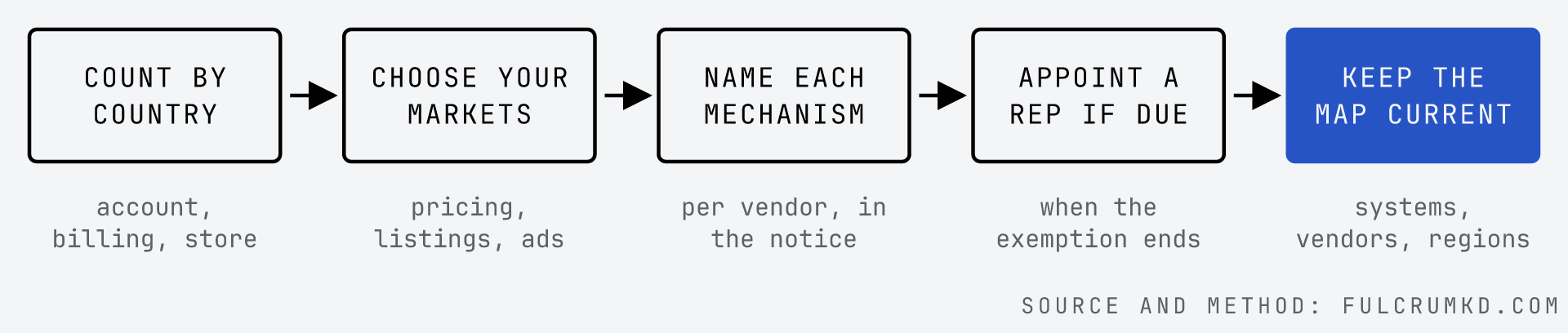
Know where your users are. The app already holds the answer in the account country, the billing address or the store that installed it, so pull the counts by country before deciding anything. Then decide which markets you actually serve. Serving a market is a choice you make in pricing, store listings and marketing, and it is the choice that brings Article 3(2) and the state thresholds into play.
Write the transfer mechanism into the privacy notice per vendor: adequacy for the EU, the UK Extension for a listed US vendor, the IDTA or the Addendum for one that is not listed. Add the EU representative only when the exemption stops applying, and write down the date you judged that. If your build shipped without any of this, the four checks in the survival guide come first, because a leaked key is a breach in every country at once.
The document that holds all of this together is a data map: each system, each vendor, the region it runs in, the countries of the people in it, and the mechanism that covers each hop. Keeping it current is the whole job. Fulcrum's free Code Health Check produces that map from the code, because the code is where the vendors, regions and data flows actually are. The rest of the layer around your app is set out in the hub piece.
Where are your users, which law, which mechanism
Common questions
- Do I need an EU representative?
- Only when Article 3(2) applies, meaning you offer the service to people in the EU or monitor their behaviour there. Article 27 then requires a representative in a Member State where your users are, unless your processing is occasional, involves no large-scale special category data and is unlikely to put people at risk. A small app with a few EU accounts and ordinary profile data usually fits that exemption. Record the date you judged it.
- Does hosting in the EU take my UK company outside the UK GDPR?
- No. Article 3(1) of the UK GDPR applies to processing in the context of a UK establishment regardless of where the processing takes place. Hosting in Frankfurt changes the transfer question and nothing else. You still owe UK users a lawful basis, a notice and their rights.
- My app has US users. Does the CCPA apply to it?
- Only if you meet one of the thresholds on the California Privacy Protection Agency's FAQ: gross annual revenue of $26.625 million or more, buying, selling or sharing the personal information of 100,000 or more California residents or households, or 50% or more of revenue from selling or sharing it. An early-stage app with no data sales usually sits under all three. Keep counting each year.
- What do I write in the notice for Supabase, Vercel and Stripe?
- Name the mechanism per vendor. As read in September 2026, Vercel's privacy policy states it complies with the EU-US DPF and the UK Extension, and Stripe's privacy centre says Stripe, LLC is certified under both. Supabase's data processing addendum uses the standard contractual clauses and the UK Addendum. Check each vendor's DPF listing before you publish, and again when you add a vendor.
Written with AI assistance and edited by a human before publication.
// read next
- What a privacy policy for an AI-built app must say under UK GDPR
What UK GDPR Articles 13 and 14 make an app's privacy notice say, the ICO fee tiers, the 72-hour breach clock, and how to write it from what the code collects.
- Terms of service for an AI-built app under UK law, clause by clause
Terms of service for an AI-built app under UK law: consumer or business customer, which clauses hold, the liability cap, and the 14-day cancellation right.
- You shipped an app with AI and people use it. Here is the layer around it
Your AI-built app has real users. The six things that now sit around it: a penetration test, SOC 2, terms, a true privacy policy, GDPR by country, the basics.