What a privacy policy for an AI-built app must say under UK GDPR
A privacy policy for an app under UK GDPR must say who you are, why you use personal data and on which lawful basis, who receives it, how long you keep it, the rights people have, and how to complain to the ICO. Write it from an inventory of what the app actually collects, then make the code match.
In this article 6 sections
The notice is a legal duty at the point of collection
Article 13 of the UK GDPR sets the list. When you collect personal data from someone, you must tell them who you are and how to contact you, what you will use the data for and the lawful basis for each purpose, who receives it, whether it leaves the UK and under what safeguard, how long you keep it, the rights they have, and that they can complain to you and to the ICO. Where a purpose rests on legitimate interests, you say what those interests are. Where the data is a condition of the contract, you say so, and what happens if they refuse.
Timing matters as much as content. The ICO's guidance on the right to be informed says you must provide the information at the time you collect the data from the person. If you got the data from somewhere else, an imported contact list say, Article 14 applies instead, and the deadline is a reasonable period and at most one month. The wording has to be concise, intelligible and in clear and plain language. A page nobody can find, written for a lawyer, does not meet the duty even if every fact in it is right.
The consequence for a generated policy is simple. The template your AI tool produced usually gets the headings right and the facts blank. It says the app may share data with third-party service providers and names none. It says data is kept as long as necessary and gives no period. Both sentences fail Article 13 on their face, because the article asks for the recipients and for a retention period or the criteria used to set one. The fix starts with knowing what the app actually does, which is the next section.
The inventory the generated policy skips
Write down every place personal data goes. For a typical AI-built app the list is longer than the founder expects, because most of it is other people's services. The authentication provider holds email addresses and login timestamps. The database host holds everything. The payments provider holds names, card tokens and billing addresses. Analytics and error tracking receive device identifiers, IP addresses and often the contents of a failed request. The email service holds addresses and open events. And if the app sends user content to an AI model provider, that provider is a recipient of personal data too, whatever its marketing page says about training.
Each of those is a recipient, or a category of recipient, under Article 13, and several of them store data outside the UK. That makes them international transfers, which the notice must mention along with the safeguard you rely on. The rules for serving users in the EU and the US are in the country-by-country guide. For the inventory itself, six columns are enough.
The honest difficulty is that the code is the only complete record. A prompt added an analytics SDK in week two and a crash reporter in week five, and nobody wrote either down. Reading the dependency list and the outbound calls is the fastest way to build the inventory. That is a large part of what Fulcrum's free Code Health Check produces: a list of the third-party calls the code makes and the data that flows through each one. Whoever writes the notice, that list is the raw material.
- What is collected: email, name, IP address, device ID, uploaded content, payment token
- Where it is collected: signup form, SDK, server log, webhook
- Why: the purpose, in one plain sentence
- Lawful basis: contract, legitimate interests or consent
- Who receives it: the named service and the country it stores data in
- How long it is kept, and what deletes it
Lawful basis in plain words, and where consent is really needed
The ICO lists six lawful bases and says you must pick one for each purpose before you start, document it, and avoid swapping to another later without good reason. Three of them do most of the work in a small app. Contract covers what you need to deliver the service the person signed up for: their login, their subscription, their saved work. Legitimate interests covers things you need for your own reasonable purposes that the person would expect, such as security logging and fraud checks, provided you have weighed their interests against yours. Consent is for anything a person could reasonably say no to and still use the app.
The business and consumer split changes the answer. When a company buys your product, the contract is with the company, and the personal data of the staff member who logs in is usually processed on legitimate interests, since that person never signed anything. When an individual signs up for themselves, contract covers the core and consent covers the extras. Write the notice so a reader can tell which of the two they are.
Two places need consent whatever basis you picked for the rest. The first is storing or reading anything on the user's device beyond what the service they asked for strictly needs. Regulation 6 of PECR, through its Schedule A1 in force since 5 February 2026, requires consent for that. Schedule A1 carves out strictly necessary storage, collection for statistical purposes, and remembering how the app looks or works for that user, and the last two only apply if you give clear information and a simple, free way to object. Regulation 6 covers terminal equipment, which includes a phone, so SDK identifiers and fingerprinting count as much as cookies.
The second is marketing email. Regulation 22 of PECR says you must not send unsolicited direct marketing by email unless the recipient has previously told you they consent. There is a soft opt-in: if you collected the address in the course of a sale or negotiations for one, you market only similar products, and you offered a simple way to refuse at collection and in every message since, you can send without separate consent. A message whose purpose is to sell the upgrade is marketing, however it is headed. Put the tick box on the signup form and record the answer.
The ICO fee, and who is exempt
Most apps with user accounts owe the ICO a data protection fee. The ICO's fee page says organisations, including sole traders, that use personal information must pay it unless they are exempt, under the Data Protection (Charges and Information) Regulations 2018. Regulation 2 puts the test the other way round: a controller pays unless every bit of its processing is exempt, so one non-exempt purpose brings the whole organisation in.
The tiers, as amended from 17 February 2025 by SI 2025/63, are set in regulation 3. Tier 1 is £52 and covers a controller with turnover of £632,000 or less, or ten or fewer staff, or a registered charity, or a small occupational pension scheme. Tier 2 is £78 for anyone outside tier 1 with turnover of £36 million or less, or 250 or fewer staff. Tier 3 is £3,763 for everyone else. Paying by direct debit takes £5 off each. A founder with a small team and modest revenue sits in tier 1.
The exemptions are in the Schedule to the Regulations. Exempt processing includes staff administration, advertising and public relations for your own business, keeping accounts and records of transactions, the affairs of a not-for-profit body, personal and household use, and processing that is not automated at all. An app that holds user accounts to deliver a service is doing something outside every one of those, so the exemption test fails at regulation 2 and the fee is due. If in doubt, the ICO's exemption checker on its fee pages walks through it.
Rights, retention and the one-month window
The notice has to list the rights, and then the app has to honour them. The ICO lists eight: to be informed, access, rectification, erasure, restriction, portability, objection, and rights around automated decisions. Article 12A gives you one month from the request, or from the point you confirmed the person's identity if you asked, and lets you add two months where the request is complex or you have many of them. The clock pauses while you reasonably wait for information you need to find the records. Article 12(5) says the response is free unless the request is manifestly unfounded or excessive.
Retention is where a generated policy is most often silent. Article 13 asks for the period you keep data for, or the criteria you use to set it, so write a real one: account data for the life of the account and a stated number of days after closure, server logs for a stated number of days, and so on, at figures you can defend. Then make the app able to keep the promise, which usually means a scheduled job that deletes on time and a deletion path a user can trigger.
The ICO's erasure guidance sets the bar for that path. You respond within one month at the latest. If you shared the data with other organisations, you contact each of them, unless that is impossible or a disproportionate effort. And you erase from backup systems as well as live ones, or put the data beyond use where immediate deletion is not possible. A delete button that removes the user row and leaves their events in the analytics tool and their address in the email list is a promise the code breaks. The survival guide covers the backup and test work that sits underneath.
If the app could be used by anyone under 18, the ICO's Age Appropriate Design Code applies whether or not you aimed it at them. It is a statutory code under section 123 of the Data Protection Act 2018, with fifteen standards including transparency, default settings, data minimisation, data sharing, geolocation, profiling and nudge techniques. Each of those is a design decision the notice then has to describe truthfully. Decide, and write down, whether children are likely to use the app. If the answer is yes, the code shapes the defaults and the notice together, and the ICO's guidance page is the place to start.
The breach clock, and the route from inventory to notice
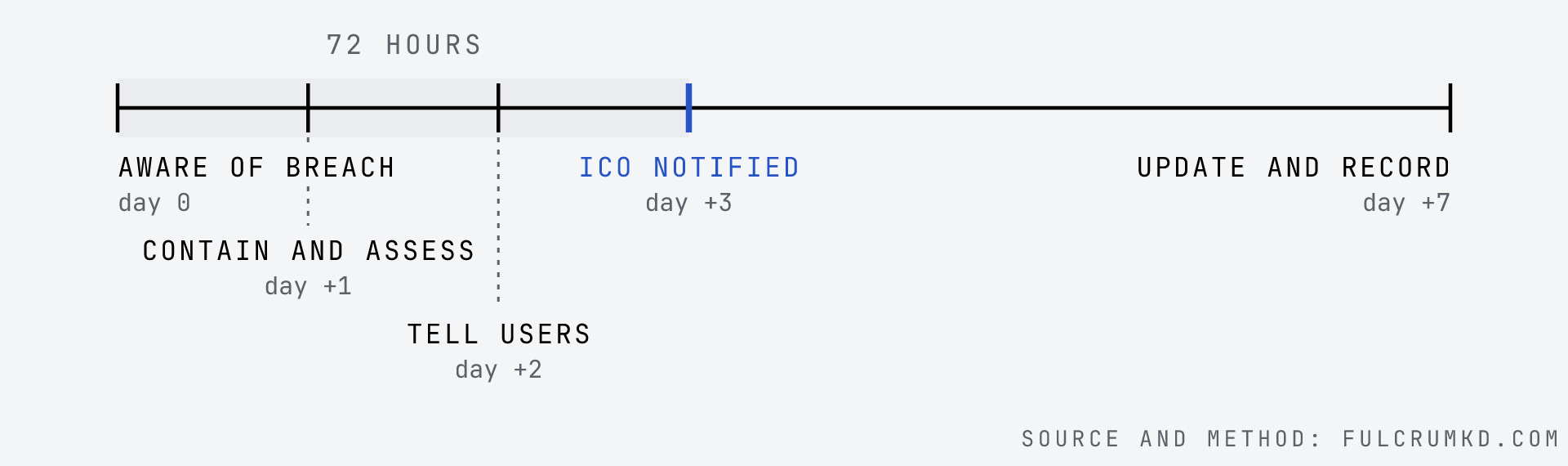
Article 33 starts the clock when you become aware of a personal data breach. Unless the breach is unlikely to result in a risk to people's rights and freedoms, you notify the ICO without undue delay and, where feasible, within 72 hours. Miss that and the notification must carry the reasons for the delay. The report describes the breach and the rough number of people and records affected, gives a contact, sets out the likely consequences, and says what you have done and will do. The ICO's reporting page says report early and update later, so an incomplete report inside the window beats a complete one outside it.
Article 34 adds a second duty when the risk to people is high: tell them, without undue delay, in clear and plain language, with the same contact, consequences and measures. You can skip that only where the data was unintelligible to whoever took it, for instance properly encrypted, or where you have since removed the high risk. Article 33(5) then requires a record of every breach, its effects and what you did, reportable or not. For the leaked secrets and open records that AI coding tools write by default, that record is also your evidence that you handled it properly.
The route has three steps and they go in this order. Build the inventory from the code and from the dashboards of every service the app uses. Write the notice from the inventory, one paragraph per Article 13 item, naming the services and the periods. Then make the app match: a deletion path that reaches every recipient, an export, a retention job, and a consent record for cookies and marketing. Do the same exercise for the contract in the terms of service piece, because the two documents have to agree on what the service is.
Fulcrum's part is the first step and the evidence for the third. The free Code Health Check reads the code and lists the outbound calls, the SDKs, the stored fields and the data flows between them, which is the inventory a notice has to rest on. It also shows whether a deletion request can actually complete. Fixed-scope work after that is a separate conversation. The rest of the layer around an app that has shipped is set out in the hub piece.
The breach clock under UK GDPR
Common questions
- Do I need to register with the ICO for a small app?
- Almost certainly, if the app holds accounts. The Regulations make a controller pay unless all its processing falls inside the exempt list, which covers staff administration, your own marketing, accounts and records, not-for-profit membership, household use and non-automated processing. A service with user accounts is outside those. A sole trader with a small turnover pays tier 1, £52, or £47 by direct debit, at the figures in force since 17 February 2025.
- Can I use the privacy policy my AI tool generated?
- As a first draft of the headings, yes. As the notice, only after you have replaced every placeholder with the truth: the named services that receive data, the countries they store it in, the lawful basis for each purpose, real retention periods, and the ICO as the complaint route. Article 13 asks for those specifics, and a generated template rarely has any of them.
- Does a mobile app need a cookie banner?
- A banner is one method; consent is the duty. Regulation 6 of PECR covers storing or reading information on terminal equipment, and a phone is terminal equipment. Analytics SDKs and advertising identifiers need consent unless one of the Schedule A1 exceptions applies, and the statistics exception only works with clear information and a simple, free way to object. Strictly necessary storage, such as the session token, needs no consent.
- What if I find the breach after the 72 hours have already passed?
- Report anyway. Article 33 counts the 72 hours from when you became aware, and a late notification must state the reasons for the delay. The ICO asks you to report early and update later, so send what you know and add the rest without undue delay. Record it under Article 33(5) whether or not you report.
Written with AI assistance and edited by a human before publication.
// read next
- You built an app with AI and people use it. Now what?
Four checks for founders whose Cursor, Claude or Lovable app now has real users: secrets, backups, tests, and when to bring in an engineer.
- The authorisation bug AI coding tools write by default
AI assistants reliably write routes that check who you are but never check what you are allowed to see. How the bug looks, why tests miss it, and how to audit for it.
- GDPR by country: what changes when your AI-built app has users abroad
The law follows the user, not the server. What UK GDPR, EU GDPR and US state laws ask of a UK app with users abroad, and which transfer mechanism to name.