SOC 2 for an app you built with AI, what it costs and who asks for it
SOC 2 is an attestation report written by a licensed CPA firm about your security controls. It is not a certificate. A customer's procurement team asks for it, usually at a mid-size or enterprise buyer. If nobody has asked yet, you almost certainly do not need one this quarter. Get a penetration test and a security page first.
In this article 6 sections
What SOC 2 actually is
SOC 2 comes from the AICPA, the US accountancy body. The AICPA describes SOC as a suite of services that CPAs may provide, producing assurance reports for the people who rely on an outsourced service (AICPA SOC overview). So the output is a report, written by an independent CPA firm, with an opinion in it. There is no certificate, no badge and no register to be listed on. When a buyer says "are you SOC 2 certified", they mean "send me your report".
The report measures you against the Trust Services Criteria. The AICPA publishes five categories: security, availability, processing integrity, confidentiality and privacy (2017 criteria, 2022 points of focus). Security is the one every SOC 2 covers. Linford & Company, a CPA firm that performs these audits, puts it plainly: the only criteria required in a SOC 2 examination are the security criteria (Linford on the criteria). The other four are added when the service calls for them. A small SaaS on its first report usually scopes security alone, sometimes with availability if customers care about uptime.
The criteria are written as outcomes, with no list of products to buy. They ask whether access is restricted, whether changes are controlled, whether incidents are detected and handled, and whether you can show evidence of each. That is good news for a small team. The evidence can be a Git history, a cloud console and a short set of policies, as long as it is real and consistent across the whole period the auditor looks at.
Type 1, Type 2 and the observation window
A Type 1 report is dated to a single day. The auditor checks that your controls are designed properly and exist on that date. A Type 2 report covers a period. The auditor tests that the same controls operated throughout that period, and pulls samples to prove it (Linford, what is SOC 2). Vanta and Drata both put that period at 3 to 12 months, with 3 months the minimum most auditors accept. Drata calls 6 months a common first choice (Drata, Type 1 vs Type 2). Secureframe advises at least a 6-month window for a first report and says mature companies settle into 12 (Secureframe timeline).
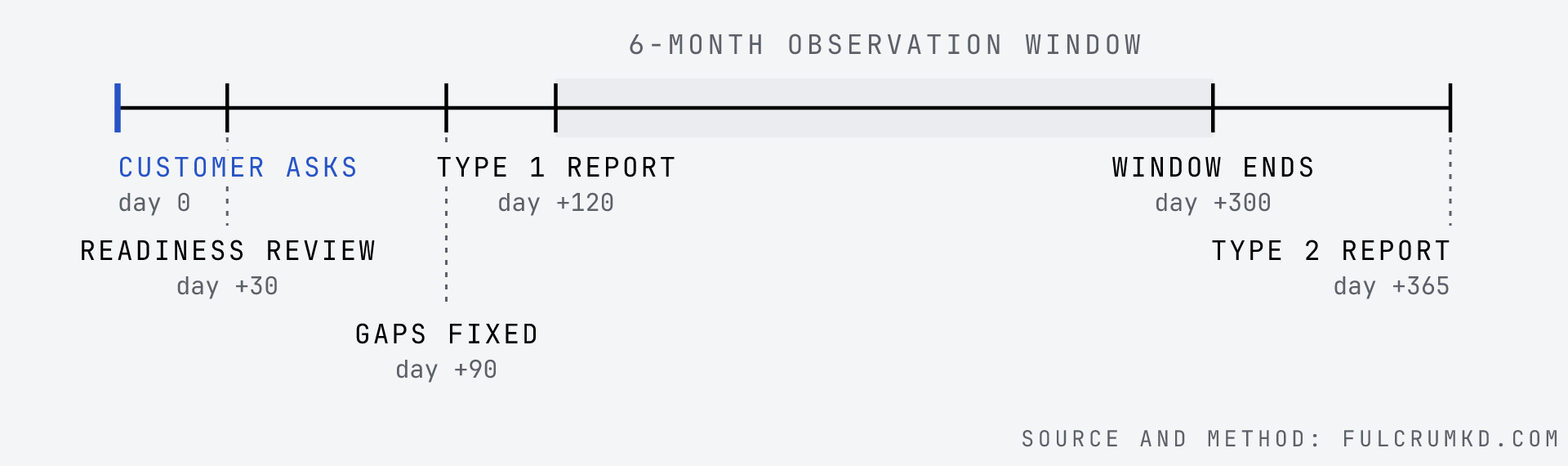
The observation window is the part founders underestimate. It cannot start until the controls are actually running, because the auditor will sample evidence from inside it. If you switch on MFA in week 3 of a 6-month window, the auditor sees 5 months of MFA and a gap. Work backwards from the day a customer needs the report. Readiness and gap fixes take 1 to 3 months on Vanta's published timeline. Then the window. Then 2 to 5 weeks of audit fieldwork and 2 to 6 weeks for the report to be written (Vanta timeline).
Put together, the honest calendar from the day a customer first asks to a Type 2 report in their hands is roughly a year for a first-time company. A Type 1 can arrive in around 3 to 4 months and buys goodwill while the window runs. Drata's guide is blunt that enterprise procurement teams overwhelmingly expect a Type 2, so treat the Type 1 as a milestone on the way and plan the window from day one.
From the day a customer asks to a Type 2 report
Who asks for it, and when the answer is not yet
Secureframe's guide states the plain truth: most service organisations pursue SOC 2 because their customers are asking for it (Secureframe, what is SOC 2). Drata's overview says no law requires it, and that enterprise B2B buyers treat it as table stakes (Drata overview). The request arrives through a security questionnaire, an RFP that lists SOC 2 as a requirement, or a renewal that suddenly depends on it. Vanta adds a useful detail: a buyer who would otherwise send a long questionnaire will often clear you on the strength of the report alone (Vanta on Type 2).
So the answer to "do I need SOC 2" is a question back: who is asking? If you sell to consumers, or to small businesses that have never sent you a questionnaire, nobody is. Drata's overview says organisations that do not store customer data or serve other businesses typically do not need SOC 2. A solo founder with a paying consumer app sits closer to that end than to the enterprise end. Spend the money on a penetration test and a plain security page on your website instead. Both cost a fraction of an audit and answer the question the next customer will actually ask.
The moment the answer changes is easy to spot. A mid-size or enterprise prospect sends a vendor security questionnaire with a SOC 2 line on it. Vanta describes the trigger as a stalled deal, a prospect who will not accept a Type 1, or a move into a larger account. When that email lands, start with readiness, because the clock on the observation window only starts once the controls are live. Until then, the penetration test and the authorisation sweep are the work that matters.
What a first-time small company has to have in place
Secureframe's requirements guide is careful to say there is no fixed SOC 2 checklist, because the criteria describe outcomes (Secureframe requirements). In practice a first Type 2 for a small SaaS turns on the same handful of controls every time. The list below is drawn from that guide and from the criteria's own points of focus. Each item needs to exist, be written down, and leave evidence the auditor can sample.
Readiness comes before any of this goes near an auditor. Secureframe describes a readiness assessment as an examination by a service auditor that ends in a letter summarising the gaps, so you fix them before the real audit (Secureframe readiness). A compliance platform can run a similar gap check against your cloud accounts automatically. Either way, the output is a list, and the list is the plan. Nothing on it is exotic. All of it takes longer than a weekend, which is why the window starts later than founders expect.
- Written policies: information security, access control, change management, incident response, vendor management, data retention. Short is fine. Signed and dated matters.
- Access control: a named account for every person, least privilege, multi-factor authentication on the cloud console, the repo and email, and an access review on a schedule (quarterly in Secureframe's description).
- Logging and monitoring: production systems monitored, logins and admin actions logged, alerts that reach a human.
- Change management: a controlled path from change to production with review and a record. In a small team that is pull requests, one required approval and a deploy log.
- Vendor list: every third party that touches customer data, what it holds, and its own SOC 2 or equivalent on file.
- Incident response: a written plan, a named owner, and at least one exercised run-through with notes.
- Risk assessment, backups with a tested restore, and a business continuity note, because availability questions arrive even when you scope security alone.
What an AI-built app usually lacks against the criteria
The studio reads a lot of code that Cursor, Lovable, Bolt and Replit produced, and the gaps against SOC 2 are consistent. The app works. What is missing is the layer the criteria care about, and every item on this list is fixable in days once someone owns it.
Audit logging is the first gap. OWASP's Top 10 gives logging and monitoring failures a category of their own, and describes the failure exactly: auditable events such as logins, failed logins and high-value transactions are not logged, or logs are only stored locally (OWASP A09). An AI assistant asked for a login route writes the login. Nobody asks it for the log line, so there is none. A Type 2 auditor will ask for evidence that admin actions were recorded across the whole window, and a blank answer stalls the audit.
Shared admin credentials and secrets in the repository are the second and third. One founder login on the cloud console, shared with a contractor, fails the access control criteria on named accounts and on MFA at once. Keys pasted into source to make a feature work were covered in the first piece on AI-built apps: rotate them, move them to a secrets store, scrub the history. OWASP's security misconfiguration category lists the related habits: default accounts left enabled, unnecessary services switched on, error pages that print stack traces (OWASP A05).
Change control is the fourth, and the one that surprises people. Pushing straight to main from a laptop is how the app got built. Under the criteria it is an uncontrolled change path. The fix is mechanical: a protected main branch, pull requests with one required review, CI that runs the tests, deploys that leave a record. Then there is the authorisation bug, OWASP's number one category (OWASP A01), which a pen test finds and an auditor does not. The authorisation piece and the penetration testing piece cover that side; the hub ties the technical work and the paperwork together.
What it costs, from published figures only
The three big compliance platforms publish no prices on their pricing pages. Vanta's page lists four plans and invites you to request personalised pricing (Vanta pricing); Drata's and Secureframe's list plan names only. All three read that way in September 2026. Their guides do publish ranges for the audit itself, and one CPA firm does too. Every figure below is in US dollars, because every source is a US firm, and each carries the month it was read.
For the audit fee alone: Drata's cost guide, dated March 2026, gives a Type 1 at $7,500 to $15,000 and a Type 2 at $12,000 to $20,000 for small to mid-size companies (Drata cost guide). Secureframe's guide, read September 2026, gives a Type 1 at $5,000 to $20,000 and a Type 2 from $7,000 upwards (Secureframe cost guide). Vanta puts the report itself at $10,000 to $50,000 (Vanta cost guide). Linford & Company wrote in February 2026 that SOC audit fees typically range from $20,000 to $150,000 with a median around $30,000, and that Big Four firms start in the low six figures (Linford on cost).
Then the rest. A readiness assessment runs $10,000 to $17,000 on Secureframe's figures and starts around $10,000 on Vanta's. Drata's worked example for a 25-person startup lands at roughly $28,000 for a first Type 2 all-in, and Vanta gives $10,000 to $80,000 or more for a first SOC 2 all-in. Drata also puts annual maintenance at $15,000 to $40,000, which is the number that matters after year one. Platform subscriptions sit on top of all of this and are quote-only.
Read against a small company's runway, that is why "not yet" is often the right answer. A Code Health Check from Fulcrum is free and tells you which of the gaps in the previous section you actually have. Closing them is fixed-scope work whether or not an audit follows. When the customer's questionnaire does arrive, readiness is short because the controls already exist, and the observation window can start the same month. More pieces on this layer sit under tips.
Common questions
- Is SOC 2 a certification?
- No. It is an attestation report with an independent CPA firm's opinion in it, issued under AICPA standards. There is no certificate and no central register. What you hand a customer is the report itself, usually under NDA, and it is dated: a Type 1 to a day, a Type 2 to a period.
- Should I get a Type 1 or go straight to Type 2?
- If a customer has asked and will accept a Type 1, get it, because it can arrive in around 3 to 4 months while the Type 2 window runs. Drata's guide says enterprise procurement overwhelmingly expects a Type 2, so plan for both from the start. Secureframe and Drata both point to a 6-month first window.
- Do I need SOC 2 if I sell to consumers?
- Usually not yet. Drata's overview says organisations that do not serve other businesses typically do not need it, and the request nearly always comes from a business buyer's procurement process. A penetration test and a security page answer consumer trust questions at a fraction of the cost.
- Can a compliance platform replace the auditor?
- No. Vanta, Drata and Secureframe collect evidence and run the gap check; a licensed CPA firm still performs the examination and signs the report. The platforms publish no prices on their pricing pages as of September 2026, so budget for the subscription and the audit fee separately.
Written with AI assistance and edited by a human before publication.
// read next
- You shipped an app with AI and people use it. Here is the layer around it
Your AI-built app has real users. The six things that now sit around it: a penetration test, SOC 2, terms, a true privacy policy, GDPR by country, the basics.
- Penetration testing an AI-built app: what a real test does, finds and costs
What a penetration test does that a scan cannot, why a small AI-built app is scoped to two or three days, the findings that repeat, and what a UK test costs.
- The authorisation bug AI coding tools write by default
AI assistants reliably write routes that check who you are but never check what you are allowed to see. How the bug looks, why tests miss it, and how to audit for it.